

royal coronation
- noun
- /ˈrɔɪəl ˌkɔrəˈneɪʃən/
- Formal
- The royal coronation took place in Westminster Abbey.
Examples
-
The cathedral was chosen as the venue for the royal coronation, continuing a centuries-old tradition.
-
Plans for the royal coronation have been underway for months, with elaborate decorations throughout the city.
-
The royal coronation attracted thousands of spectators from all over the world.
-
Did you watch the royal coronation on TV?
-
The royal coronation of the new king will take place next month at Westminster Abbey.
-
At the royal coronation, the monarch received a crown, scepter, and orb as symbols of their reign.
-
Many people gathered to witness the spectacular royal coronation ceremony held in the main square.
Synonyms

 46
5.3
46
5.3

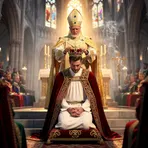
A ceremony where people place a crown on a new king or queen to show official power
 2
9.9
2
9.9
A formal ceremony where a king or queen is crowned in a religious ritual
 1
9.1
1
9.1
A formal ceremony that gives someone an official position, rank or honor with symbols like a badge
 1
9.0
1
9.0
A formal ceremony that places a new king or queen on the throne
 1
6.0
1
6.0
A formal event where a king or queen is officially crowned

A formal ceremony where officials place a new king or queen on the throne
Surface Forms
Morphology
The meaning is directly compositional: 'coronation' already denotes the ceremony to invest a monarch, and 'royal' simply specifies that it concerns a king or queen, so no idiomatic shift occurs. This straightforward modifier+noun structure is cross-linguistically common, so a B1 learner who knows both constituents will understand the phrase.
Etymology
Royal coronation comes from old public ceremonies when a king or queen had a crown placed on their head and was given special items like a scepter while church leaders blessed them. This public, formal act made them the ruler in the eyes of the people, so the phrase now means 'the formal ceremony to make a monarch officially crowned'.