
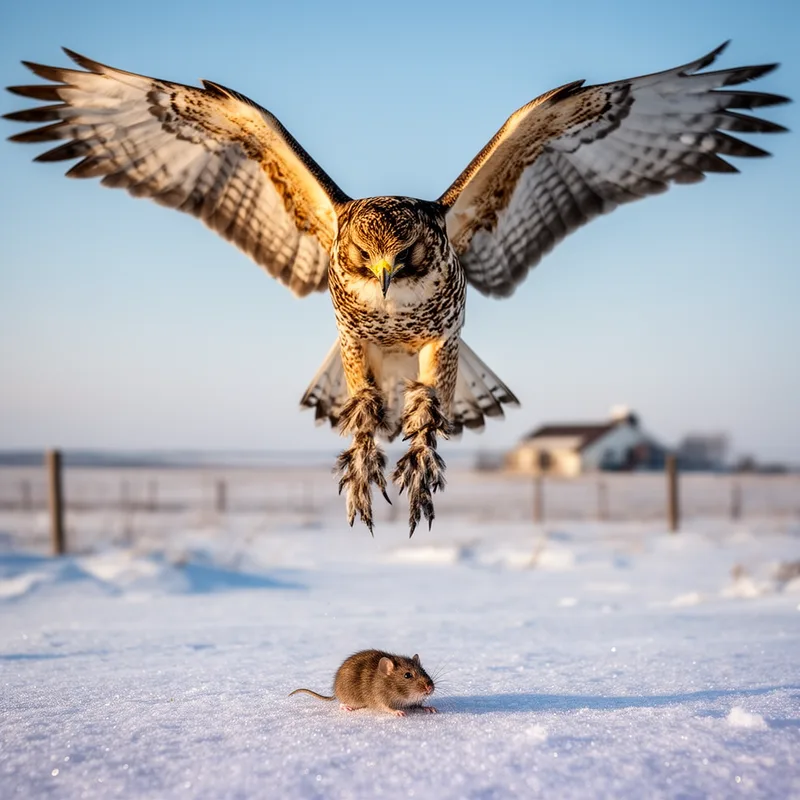
rough-legged hawk
- noun
- /ˈrʌfˌlɛɡd hɔk/
- Specialized
- Farmers appreciate the presence of rough-legged hawks, as they help control the population of pests in their crops.
Examples
-
A rough-legged hawk hangs like a kite on the wind.
Fiction book (1993) -
Boaimmas, a rough-legged hawk, screams at me.
Academic text (1998) -
Only northern goshawks and rough-legged hawks do not drift far south.
Fiction book (2001) -
In another, we see a rough-legged buzzard (the current name is rough-legged hawk) feeding on a smaller dead songbird in what is, significantly, a dead tree (ill. 5).
Academic text (1995) -
A rough-legged hawk soared gracefully above the fields, searching for small rodents to eat.
-
During winter, a rough-legged hawk can often be seen perched on fence posts, watching for signs of prey in the snow-covered landscape.
Synonyms
A large hawk with feathered legs that eats small rodents in northern regions

A large hawk from northern regions that eats small rodents
Surface Forms
Morphology
rough-legged + hawk
The phrase is a straightforward adjectival compound: 'rough-legged' (from 'rough' + 'legged') describes a quality of the hawk, so a learner who knows 'rough', 'leg/legged', and 'hawk' can infer it refers to a hawk with notably rough/feathered legs. The meaning is descriptive and compositional rather than idiomatic, following common adjective + noun patterns that are cross-linguistically transparent.
Etymology
Rough-legged hawk gets its name from its thick, feather-covered legs that make it look rough-legged. Those feathered legs help the bird stay warm and catch small animals like mice and voles, so the name fits a hawk that often helps farmers by eating pests.

