
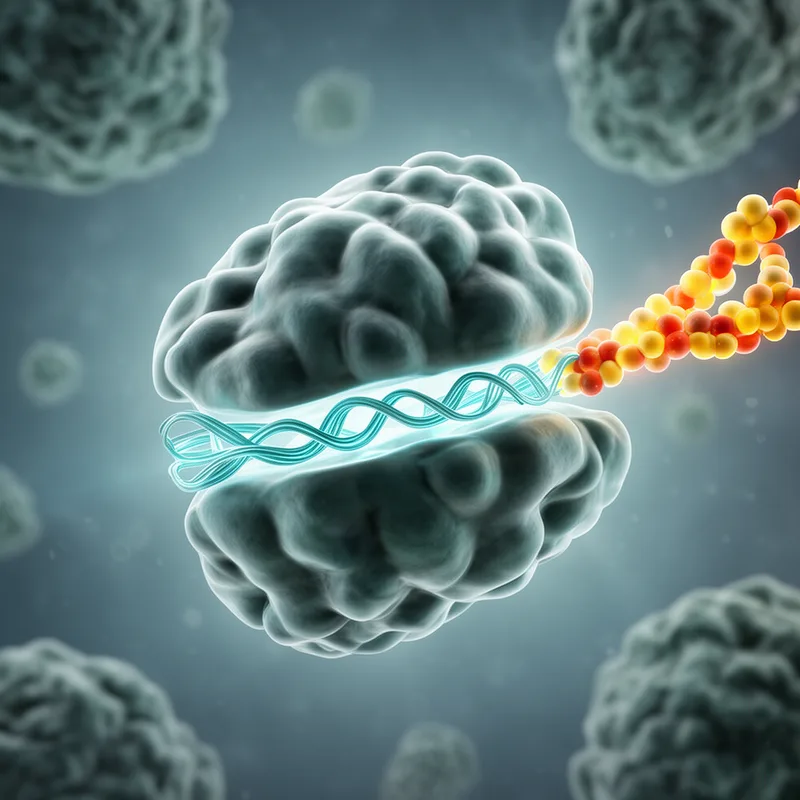
ribosome
 2
7.5

- noun
- /ˈraɪbəˌsoʊm/
- Specialized
- For coding regions, transcription results in a complementary mRNA molecule that, with no further modification, is translated at the ribosome.
Loading YouTube…
Watch on YouTubeHow does a cell turn on ribosomes, turn them off?
- How does a cell turn on ribosomes, turn them off?
- That mRNA gets translated by a ribosome into a polypeptide chain or a protein.
- So Astrophage in fact, has mitochondria and ribosomes and everything.
- So the most beautiful and most complex RNA machine known to man is the ribosome.
- Why would you put the the ribosome as the central part of living organisms on Earth?
- So the ribosome allows the mRNA, the messenger RNA.
Examples
-
Three separate single strands of RNA studded with several dozen proteins make up the ribosome's large and small subunits.
Academic text (2004) -
So in addition to the ribosome, we have the mRNA.
-
That mRNA gets translated by a ribosome into a polypeptide chain or a protein.
-
The small subunit of the ribosome contains the medium-length RNA, whose gene has become key for microbial identification.
Academic text (2004) -
Though E. coli O157:H7 can harm humans by deactivating ribosomes and destroying kidney cells, cattle can host them without harm.
Academic text (2006) -
Microsporidia are tiny, unicellular zoonotic parasites that contain ribosomes but lack mitochondria.
Academic text (1998) -
The large subunit of the ribosome has two strings of RNA, one long and one short; the long string functions as a ribozyme, providing enzyme-like activity that forms the peptide bond between amino acids.
Academic text (2004) -
Ribosomes are essential for synthesizing proteins in the cell according to the instructions from messenger RNA.
-
During translation, the ribosome reads the sequence of mRNA to assemble the corresponding amino acids into a protein.
-
Each ribosome functions as a factory within the cell, converting genetic information into functional proteins.
Synonyms
A tiny part of a cell where the cell makes proteins from messenger RNA
Surface Forms
Morphology
ribosome = ribo + some
Formed from specialized combining forms ('ribo-' and '-some') that are not productive or recognizable to average B1 learners, so the meaning cannot be derived from common English words.
Etymology
Ribosome comes from ribo- (from ribose, the sugar in RNA) and -soma meaning 'body'. That's why a ribosome is a tiny 'body' in the cell that reads RNA and builds proteins.