
rhapsody


 1
9.6
1
9.6
- noun
- /ˈræpsədi/
- Literature
- Successive events may be depicted one after another on a common background, with the figures repeated as needed, as in some scrolls illustrating the Rhapsody on the Goddess of the Luo River (Luoshen fu, Fig. 12).
Loading YouTube…
Watch on YouTubePlato supposed that the poetry of the Rhapsodies was inspiration, literally the inhalation of the breath of the Muses.
- Plato supposed that the poetry of the Rhapsodies was inspiration, literally the inhalation of the breath of the Muses.
Examples
-
Plato supposed that the poetry of the Rhapsodies was inspiration, literally the inhalation of the breath of the Muses.
-
In the section reproduced from the scroll in the Beijing Palace Museum, a landscape resembling stage scenery provides a continuous setting for three apparitions of the lovely goddess, who performs various alluring actions described in the rhapsody.
Academic text (1998) -
And he's going to call Aristotle's work a Rhapsody at several different points.
-
The rhapsody also recounts how the author's visit to the mill satisfied his intellectual curiosity about hydraulic engineering.
Academic text (2002) -
William Warburton found Night Thoughts "a dismal rhapsody, and the more dismal for being full of poetical images all frightful, without design or method."
Academic text (2016) -
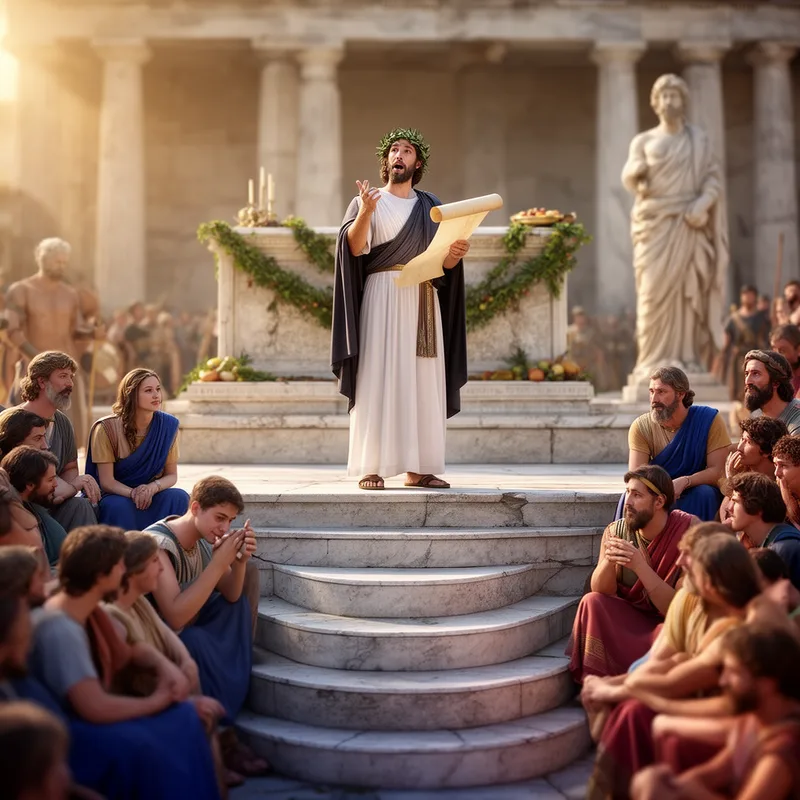
In ancient Greece, a famous rhapsody was recited in honor of the gods during public festivals.
-
The audience was captivated by the emotional rhapsody performed by the poet at the gathering.
-
As the festival progressed, the storytellers took turns sharing their rhapsodies to celebrate their culture.
Synonyms
 3
6.7
3
6.7
A long poem that tells the adventures and deeds of a famous hero

A long poem that tells the stories of heroes and shows a society's values
How Long

Surface Forms
Etymology
Rhapsody originally meant a part of an epic poem from Greek rhaptein 'to sew' and aeidein 'to sing'. Poets or reciters would join verses into a single performance, so a rhapsody was a 'stitched' song meant for public recitation and strong feeling.