
relaxation time


 1
6.8
1
6.8
- noun
- /rɪˌlækˈseɪʃən taɪm/
- Specialized
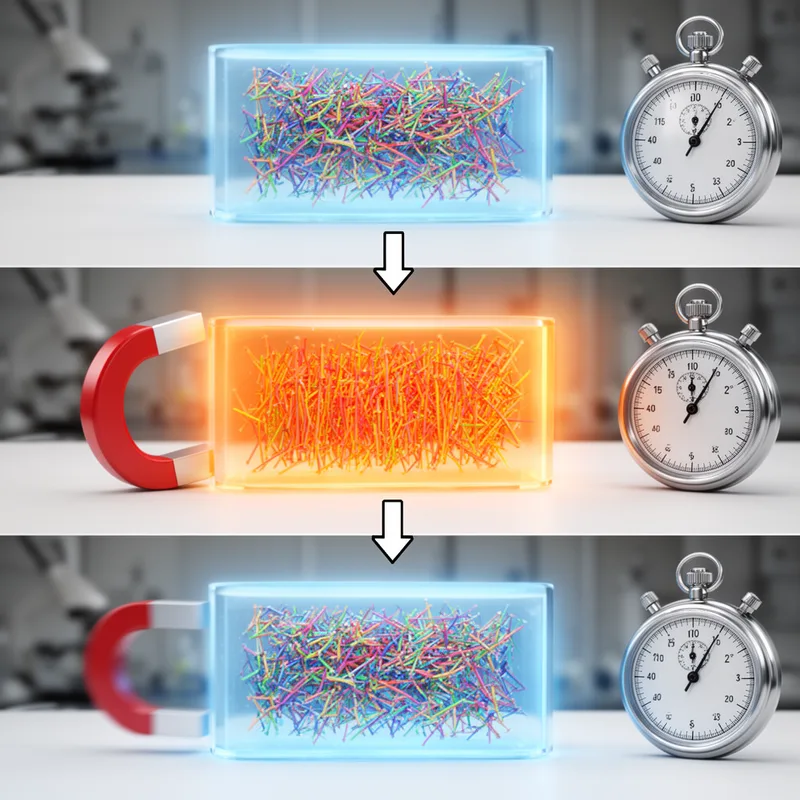
- In this experiment, we measured the relaxation time, which indicated how quickly the system stabilizes.
- isovolumic relaxation time
- thermal relaxation time
- long relaxation time
Examples
-
This decaying signal following the 90-degree pulse is called a free-induction decay; its relaxation time T2 is called the transverse relaxation time.
Academic text (1993) -
Due to the long relaxation time scale (a few millennia) for Earth's viscoelastic rebound, the ice melted back into its own hole.
Academic text (2002) -
Here we use corn oil with a relaxation time of about one second.
-
This process is rather slow, but the nuclear spin has such a long relaxation time that the pumping process can be very effective.
Academic text (2002) -
A possible improvement is to shorten the relaxation time required to switch the active device from the hand back to the elbow.
Academic text (1990) -
The relaxation times Tsub1 and Tsub2 are significant for medical applications of NMR.
Academic text (1993) -
The issue with the Schwartz approach is that there appear to be two relaxation times, as pointed out originally by Nicola Scafetta.
Blog text (16) -
Equations built on fractional derivatives describe the anomalously slow diffusion observed in systems with a broad distribution of relaxation times.
Academic text (2002) -
Perhaps the most useful distinctions come from the relaxation times—the Tsub1's and Tsub2's.
Academic text (1993) -
The most striking of many unusual observations is the observation of two transport relaxation times, tau, in yttrium barium copper oxide (as well as other systems in which good single crystal measurements are available).
Academic text (1997)
Surface Forms
Morphology
The phrase literally means 'the time of relaxation' — the time it takes a disturbed system to relax back to equilibrium — which is directly derivable from combining 'relaxation' and 'time'. While the precise technical nuance (an exponential time constant) is specialized, a B1 learner who knows both constituent words can infer the general meaning, so the expression is compositional and transparent.
Etymology
Relaxation time comes from the simple image of something that 'relaxes' after a push, where relaxation means to calm down and time is how long that takes. So, relaxation time is the amount of time it takes for a system to calm down and return to balance after being pushed or moved.