
red tide
 3
6.8
3
6.8

- noun
- /rɛd taɪd/
- Specialized
- Shrimp aquaculture also contributes to eutrophication and red tides.
- algal red tide
Loading YouTube…
Watch on YouTubeAnd these estuaries where red tide hasn't affected and can't affect because red tide is salt water.
- And these estuaries where red tide hasn't affected and can't affect because red tide is salt water.
- Last year they had red tide so bad that literally, I mean, thousands upon thousands of fish were dead.
Examples
-
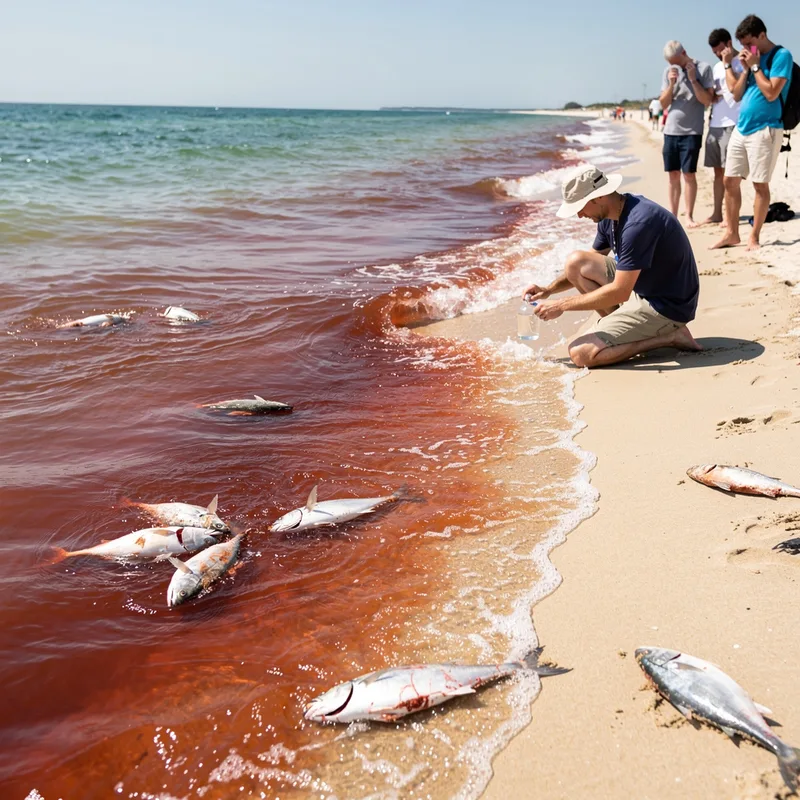
Dead fish floating in water discolored by a red tide.
Academic text (2003) -
Last year they had red tide so bad that literally, I mean, thousands upon thousands of fish were dead.
-
While its red color is the first indication of red tide, testing is needed to confirm it.
Blog text (18) -
The area hit the most annually with red tide is the Gulf Coast of Florida.
Blog text (18) -
A clean-up crew in Tampa Bay, Florida, surrounded by dead fish during a red tide.
Academic text (2003) -
Kirkpatrick's goal is to develop a way to alert coastal regions well ahead of time that a red tide is imminent.
Academic text (2003) -
Red tides now occur with greater frequency, jeopardizing the domestic shrimp aquaculture industry.
Academic text (1997) -
A red tide bloom caused by toxic algae is lingering offshore from Englewood south to Sanibel Island.
Blog text (11) -
We have always regarded the death of fish and other marine organisms during red tides as passive and unintended results of dinoflagellate toxins or other consequences of massive algal populations during blooms.
Academic text (1995) -
Last summer, a severe red tide event led to a massive fish die-off along the coast.
Surface Forms
Morphology
The meaning is directly compositional: 'red' (a color) + 'tide' (the sea/water movement) yields the notion of seawater becoming red or discoloured. Although the specific cause (algal blooms and toxins) is specialized knowledge, a B1 learner who knows both constituents will readily infer the basic phenomenon; many languages use an equivalent compound (e.g. Spanish 'marea roja'), supporting transparency.
Etymology
Red tide comes from a simple image: when tiny plants in the sea grow a lot they can make the water look red, and tide here just means the sea. These blooms can be 'harmful' and kill fish or make people sick, so red tide now means a patch of sea changed by these tiny plants that can be dangerous.