

red pine
- noun
- /rɛd paɪn/
- US
- The hike through the forest led us to a grove of tall red pines with their distinctive reddish bark.
Examples
-
We observed a squirrel climbing up a red pine while enjoying the fresh scent of its long needles.
-
However, we recognize that this treatment is unlikely to maintain red pine indefinitely should conditions become unfavorable for establishment.
Academic text (2016) -
The resilience treatment (Table 3; Figure 4) is a strategy to move beyond red pine as the dominant species but still maintain a species composition within the HRV.
Academic text (2016) -
The majority of the CEF supports forests dominated by red pine (Pinus resinosa Ait.) that are of natural fire origin circa 1918.
Academic text (2016) -
There is mounting empirical evidence that maintaining red pine stands near the lower level of stocking is effective for reducing drought impacts on growth (D'Amato et al. 2013, Bottero et al. 2017).
Academic text (2016) -
The lumber from the red pine tree is highly valued for its strength and durability in construction.
Synonyms

A pine tree from eastern North America with long needles in pairs and red bark
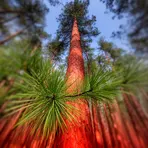
A tall eastern North American tree with long needles in pairs and red bark
Surface Forms
Morphology
The phrase is compositionally built from 'red' + 'pine', so a learner would plausibly infer a kind of pine tree with a red quality; this gives partial transparency. However, the dictionary sense refers to a specific New Zealand timber tree (rimu) that is not actually a true pine, so the precise referent and geographic/specific meaning are not predictable from the parts alone and require prior knowledge.
Etymology
Red pine is named for the tree's reddish bark and long needles; people called it red because of the bark colour and pine because it is a pine tree. So the name now refers to the tree and the timber made from it.

