

red fox
 1
3.2
1
3.2

- noun
- /rɛd fɑks/
- Climatic warming may favor red foxes.
- red fox (Vulpes vulpes)
Loading YouTube…
Watch on YouTubeI remember the last time years ago a red fox crossed in that early AM the night before and sleep paralysis.
- I remember the last time years ago a red fox crossed in that early AM the night before and sleep paralysis.
Examples
-
After the winter, the red foxes walked out of the woods and sunned themselves along the roadside.
Fiction book (1996) -
Why, a red fox skin ain't worth nothing this time of the year.
-
An adult is only about two-thirds the size of a red fox.
Academic text (1998) -
A family of red foxes scampered across the top of the slope.
Fiction book (1996) -
Forest clearing, for example, opens up the landscape, creating prime hunting habitat for red foxes.
Academic text (1998) -
The red fox is more at home at lower latitudes, where it inhabits prairies, shrublands, and forests.
Academic text (1998) -
While hiking, I spotted a red fox moving gracefully through the tall grass.
-
The red fox has distinctive reddish-brown fur, making it easy to identify in the wild.
-
At dusk, a red fox can often be seen foraging for food in the fields.
Synonyms
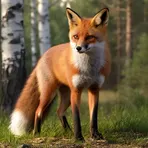
A common red fox with reddish brown fur that lives in Europe and Asia

A small wild fox with red fur that lives in North America
Surface Forms
Morphology
The noun phrase 'red fox' is transparently composed from the adjective 'red' and noun 'fox' to denote a fox that is red in color; a B1 learner who knows both words can readily infer this referent. This color + animal compounding is a common, literal, and cross-linguistically familiar pattern, so the meaning is immediately accessible from the constituents.
Etymology
Red fox comes from the animal's reddish fur and the word fox for the animal. It literally points to 'a red' kind of 'fox', so today it means the wild fox with reddish-brown fur.