
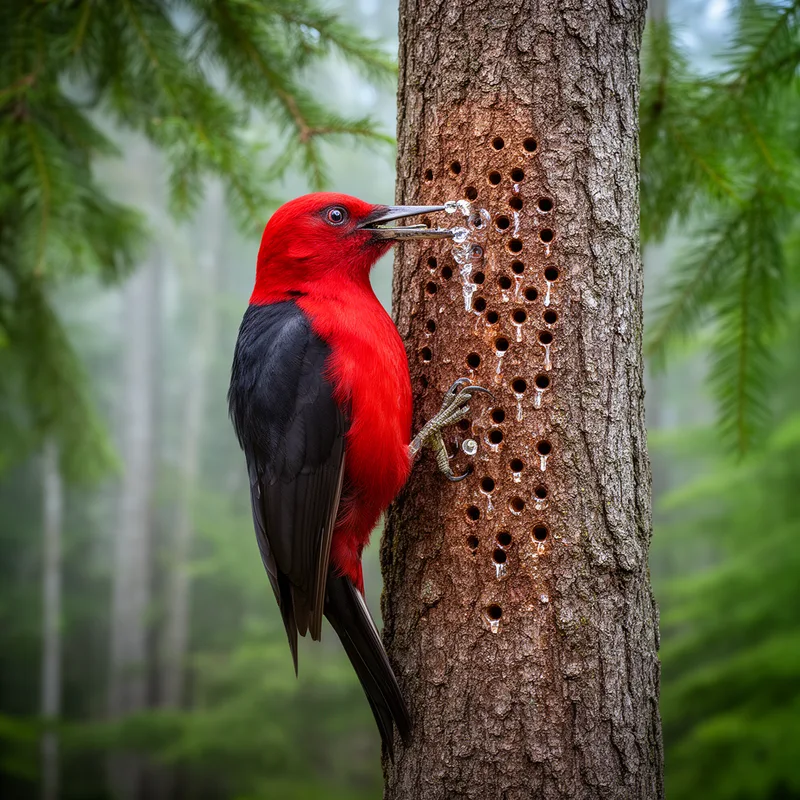
red-breasted sapsucker
- noun
- /ˈrɛdˈbrɛstɪd ˈsæpsʌkər/
- US
- The red-breasted sapsucker is often seen in coniferous forests.
Examples
-
The red-breasted sapsucker is known for drilling neat rows of holes in bark to feed on sap.
-
Unlike other woodpeckers, the red-breasted sapsucker prefers coniferous forests along the Pacific coast.
-
We spotted a red-breasted sapsucker pecking at the tree while hiking in Oregon.
-
Yesterday, I spotted a red-breasted sapsucker in the park.
-
The red-breasted sapsucker is known for drilling holes in trees to feed on tree sap.
-
In spring, the red-breasted sapsucker can be seen pecking at the bark for food.
-
Birdwatchers often spot the red-breasted sapsucker nesting in the western forests.
Surface Forms
Morphology
red-breasted + sapsucker
The noun phrase is compositionally built from 'red-breasted' (having a red breast) + 'sapsucker' (a sap‑feeding woodpecker), so a learner who knows both constituents can infer it denotes a sapsucker with a red breast. This follows regular English adjective + noun composition and is cross‑linguistically predictable, making it immediately comprehensible at B1.
Etymology
Red-breasted sapsucker comes from a simple picture: the bird has a bright red chest, so red-breasted, and it makes neat rows of small holes to 'drink' the tree sap, so sapsucker. That's why the name tells you what the bird looks like and what it does.

