
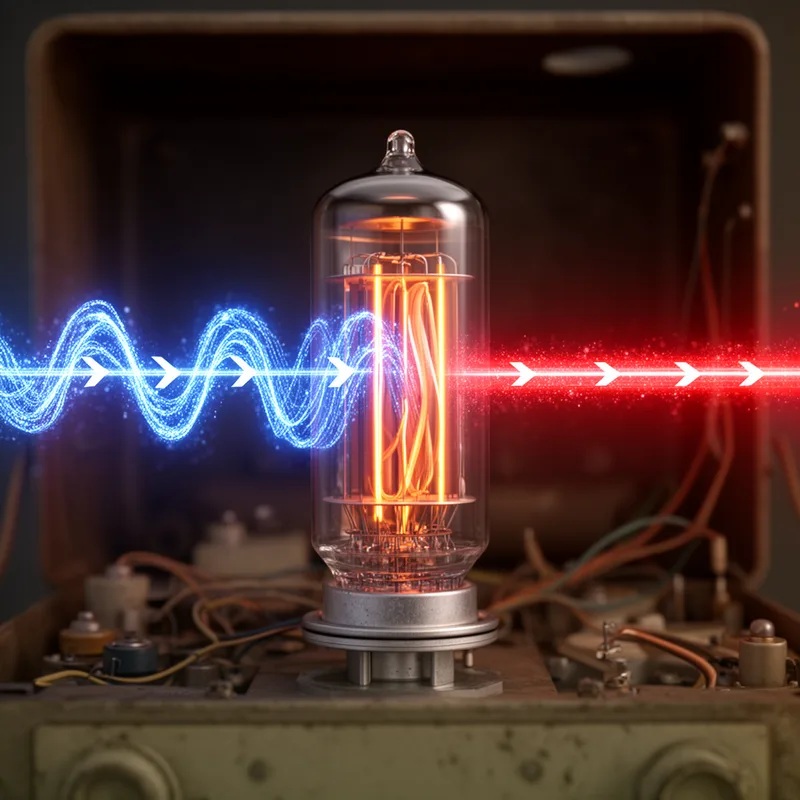
rectifying valve
- noun
- /ˈrɛktɪfaɪɪŋ vælv/
- Archaic
- Early radios often used a rectifying valve to convert AC power to DC.
Examples
-
Replacing the old rectifying valve improved the radio's performance.
-
The rectifying valve failed, causing the device to malfunction.
-
The rectifying valve is essential for converting AC to DC.
-
Many devices rely on a rectifying valve to function properly.
-
Early radios often used a rectifying valve to convert AC power to DC.
-
Replacing the old rectifying valve improved the radio's performance.
-
Many devices rely on a rectifying valve to function properly.
Synonyms

 1
7.8
1
7.8

A device that changes alternating electric current into direct current

A glass tube with two metal parts that changes alternating current into direct current
How Common
- Specialized

- Archaic
Surface Forms
Morphology
The noun is a straightforward composition of 'rectify' (to convert AC to DC) and 'valve' (a device), so its meaning — a device that performs rectification — is directly derivable from the constituents. Although the historical/technical detail that it refers to a thermionic tube may be unfamiliar, a B1 learner who knows both words will understand it denotes a device for converting alternating to direct current.
Etymology
Rectifying valve comes from the image of a valve that lets a flow go one way and rectifying meaning making the flow straight instead of back-and-forth. So a rectifying valve is a part that 'changes' 'AC', electricity that goes back and forth, into 'DC', electricity that goes one way, and that is why the name means a device that makes electric flow one-way.