

random variable
 2
6.8
2
6.8

- noun
- /ˈrændəm ˈvɛrɪəbl/
- Specialized
- In statistical analysis, a random variable can represent the outcome of rolling a die.
- sequence of random variables
- independent random variables
Examples
-
However, in many environmental science applications, X represents a random variable subject to measurement error, just like Y.
Academic text (2009) -
For example, X may be a random variable representing the true mean length of all adult trout in a particular stream.
Academic text (2009) -
In this case, price changes are completely independent random variables, and none of the market participants use inside information.
Academic text (1996) -
A model should be judged by how well it represents the random variables.
Blog text (16) -
The value theta for each item made of some metal is a realization of some random variable whose distribution depends on the variation of the total strength of the metal.
Academic text (2018) -
Researchers often use a random variable to model unpredictable events in experiments.
-
A typical example of a random variable is the number of heads obtained when flipping a coin multiple times.
Synonyms
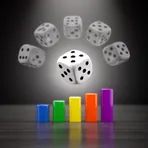
A number that can take different values by chance, for example a dice roll outcome

A number or value that can change by chance

A number that takes different values by chance in statistics to show random results
How Random
- Specialized
2
6.8

- Specialized
37
4.2
Surface Forms
Morphology
The phrase is largely compositional — 'random' + 'variable' directly suggests a variable whose values arise by chance, so a B1 learner who knows both words can grasp the basic idea. However, the full technical meaning (values governed by a probability distribution and use in probabilistic modelling) is specialized and not fully predictable from the constituents alone, so it is only partially transparent.
Etymology
Random variable comes from random meaning 'by chance' and variable meaning 'something that changes'. Imagine a closed box that gives a different number each time you open it; that number is the random variable, so the phrase means 'something that can have different values because of chance'.