
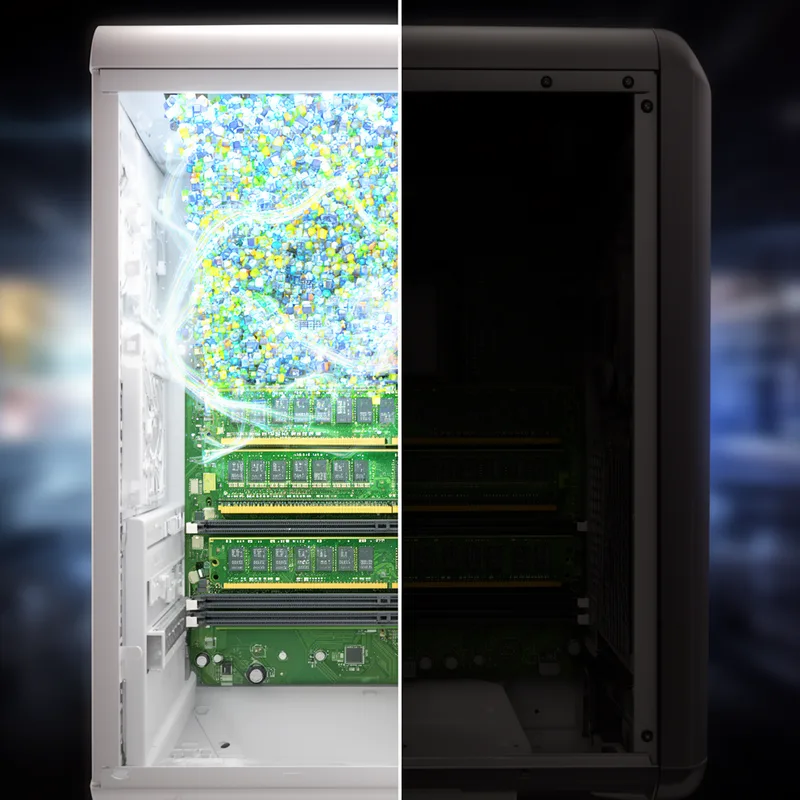
random-access memory
- noun
- /ˈrændəm ˈæksɛs ˈmɛməri/
- Specialized
- When you turn off your computer, all the data stored in random-access memory is lost.
Examples
-
Upgrading your random-access memory can significantly improve system performance.
-
The computer has 16 gigabytes of random-access memory for handling multiple applications at once.
-
The computer's random-access memory is crucial for its performance.
-
Many computers today use random-access memory for faster processing.
-
A computer with more random-access memory can run multiple applications simultaneously without slowing down.
-
Upgrading your device's random-access memory will significantly improve its performance during intensive tasks.
-
When installing new software, make sure your system has sufficient random-access memory to avoid crashes.
Synonyms

 27
3.5
27
3.5

Computer memory that stores data for a short time while the computer is on


 1
3.7
1
3.7
A fast place in a computer where programs keep data while the computer runs

A part of a computer that stores data for a short time while it runs

A part of a computer that stores data for a short time the system can read and change while running
How Writable
- Specialized

- Specialized
- Specialized
Surface Forms
Morphology
random-access + memory
The meaning 'a type of computer memory allowing data to be read or written in any order' is directly compositional from 'random' (without fixed order) + 'access' (ability to reach/retrieve) + 'memory' (storage). Although a technical term, the components transparently describe the property and many languages use an equivalent literal phrasing, so a B1 learner who knows the constituent words can reasonably infer the meaning.
Etymology
Random-access memory gives the image of a shelf where you can take any item straight away; random-access means you can get data in 'any order' instead of following a set order. That's why random-access memory is the fast memory the computer uses while it is on to hold data it needs quickly, and why what is stored there is lost when you turn the computer off.