
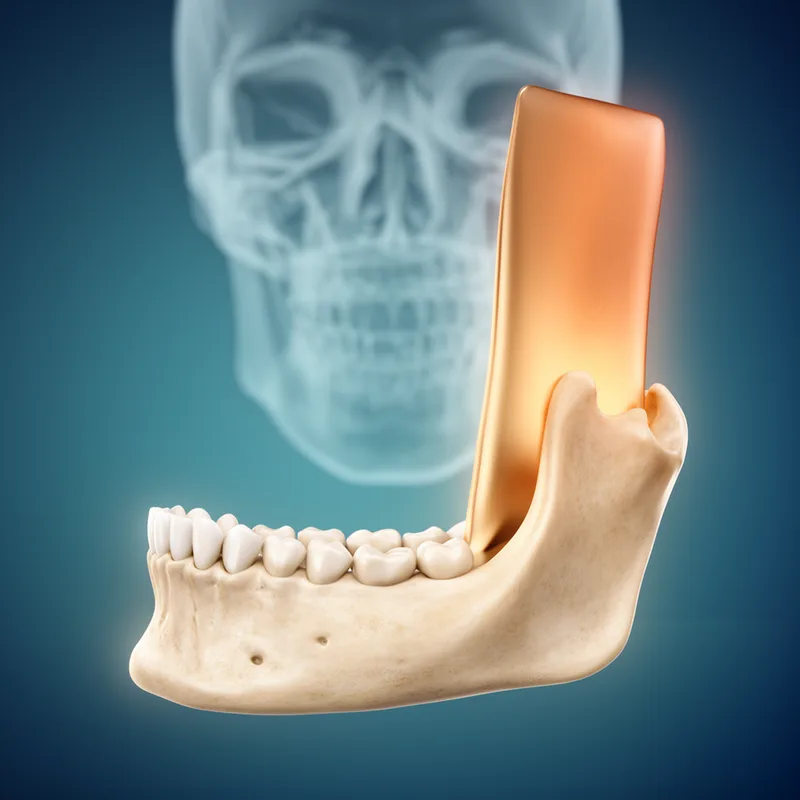
ramus
 2
9.9
2
9.9

- noun
- /ˈreɪ.məs/
- Specialized
- The mass involved the external auditory meatus laterally (Figure 1, D), and it extended inferiorly posterior to the temporomandibular joint and the ramus of the mandible.
- ramus of the mandible
Examples
-
Both subtypes usually occur in the body of the mandible and in its ascending ramus.
Academic text (2003) -
A panoramic x-ray examination revealed multilocular radiolucency in the ramus ascendens and the angulus mandibula on the right (Figure 1).
Academic text (2003) -
In its first year, more than 2 million tourists visited the library, which was designed by Dutch architect Rem Koolhaas and American designer Joshua Ramus.
Blog text (15) -
It measured 2 x 3 cm and was localized behind the posterior margin of the mandibular ramus.
Academic text (2001) -
Of particular surgical interest is a study of the mandibular ramus in stillborns by Sammarco et al. (n10).
Academic text (2003) -
The medial and lateral cortex of the mandible are separated at the ramus region, while the inferior alveolar nerve is preserved.
Academic text (1999) -
The panoramic x-ray shows the multilocular radiolucency in the ramus ascendens and in the angulus mandibula on the right.
Academic text (2003) -
While the current study found that 46% of canine region, 18% of angle, 12% of condyle, 7% of dentoalveolar, 6% of symphysis region, 6% of body, 3% of ramus, and 2% of coronoid region mandible fractures in road traffic accidents.
Academic text (2007) -
Generally, during sequential swallows, the leading edge of the bolus is caudal to the ramus of the mandible at the onset of the pharyngeal portion of swallowing.
Academic text (2011) -
The surgeon examined the ramus of the mandible to evaluate the bone structure.
Surface Forms
Etymology
The word ramus comes from Latin ramus, which means 'branch'. Doctors used this word because the upright part of the jaw looks like a small branch, so ramus now names branch-like parts of bones.