

radio drama
 2
3.5
2
3.5

- noun
- /ˈreɪdioʊ ˈdrɑːmə/
- The use of radio drama to deliver social messages was one of the strategies adopted.
- listen to radio drama
- old radio dramas
Examples
-
When listening to a radio drama, each of us forms his own images of the characters and actions.
-
What happened: I was a huge fan of the radio drama "The Hitchhiker's Guide to the Galaxy."
Blog text (11) -
When listening to a radio drama, each of us forms his own images of the characters and actions.
Academic text (1990) -
A cast of six will read all the movie's parts in what is to be WNAT's last live radio drama before the format changes to all music, all the time.
Blog text (11) -
In 1938, Orson Welles' broadcast of the radio drama War of the Worlds caused massive panic among listeners.
Blog text (16) -
Even college students decades too young to remember the radio dramas and science fiction comics that inspired "The Intergalactic Nemesis" were as engrossed as the older crowd.
Blog text (5) -
In Australia, her book was scripted into a six-part radio drama, broadcast over the ABC—that is, the Australian Broadcasting Company—which proved to be one of its most popular shows that year.
Fiction book (2001) -
In 1938, Orson Welles' broadcast of the radio drama War of the Worlds caused massive panic among listeners.
-
Afghanada is a radio drama that ran for five years.
Synonyms
 1
4.2
1
4.2
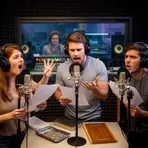
A story acted using only sound, like a radio play or podcast

A play made for listening on radio or audio recordings with actors, music, and sound effects
How Long
40
3.4
 2
3.5
2
3.5
Surface Forms
Morphology
The meaning is a straightforward composition of 'radio' (broadcast medium) + 'drama' (a staged play), so a learner who knows both words can infer it refers to a play presented via radio. This pattern (medium + genre) is common across languages, making the construction immediately comprehensible to a B1 learner.
Etymology
Radio drama comes from early broadcasts when actors performed a drama over the radio for people at home. With no pictures, voices, music and sound effects had to create the whole story in listeners' minds, so the term means 'a play or story performed on radio using only sound'.