
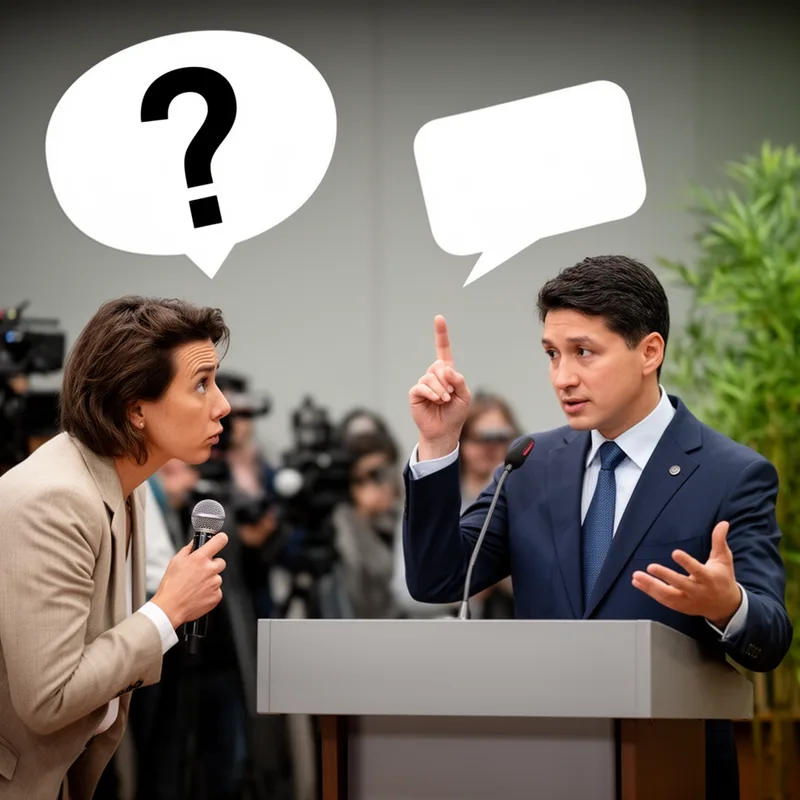
quick deflection
- noun
- With a quick deflection, he changed the subject before things got awkward.
Examples
-
His answer was just a quick deflection from the real issue.
-
The politician's quick deflection kept the press from pressing further on the topic.
-
She gave a quick deflection when asked about the controversial decision.
-
The politician's quick deflection kept the audience from asking tough questions.
-
The politician's quick deflection made it clear he was avoiding the tough questions.
-
During the debate, she used a quick deflection to steer the conversation away from her past mistakes.
-
His quick deflection in response to the accusation left everyone wondering what he was really hiding.
Synonyms

 12
6.6
12
6.6

An indirect statement that hides an unpleasant truth
 9
9.9
9
9.9
Using unclear language to hide the truth and avoid giving a clear answer
 8
6.1
8
6.1
A clever trick used to avoid answering a question
 3
7.4
3
7.4
Avoiding giving a direct answer so people do not know what you really think

A false or nonsense answer that avoids giving a direct reply
How Evasive
- Literature
42
7.8

- Literature
- Formal
3
7.4
1
3.1
Surface Forms
Morphology
The noun phrase is compositional: 'quick' (rapid) simply modifies 'deflection' (a turning away/diversion), so a learner who knows both words can infer 'a rapid attempt to divert or avoid an issue.' This follows normal adjective+noun composition and parallels similar constructions in other languages, making the meaning predictable rather than idiomatic.
Etymology
The phrase quick deflection comes from the image of a ball suddenly bouncing off a surface, where quick shows speed and deflection means a sudden turn away. So, it helps you remember that a 'quick deflection' is a fast move to 'avoid' a question or 'change the subject'.