
quattrocento


 1
9.9
- noun
- /kwɑːtrəˈtʃɛntoʊ/
- Formal
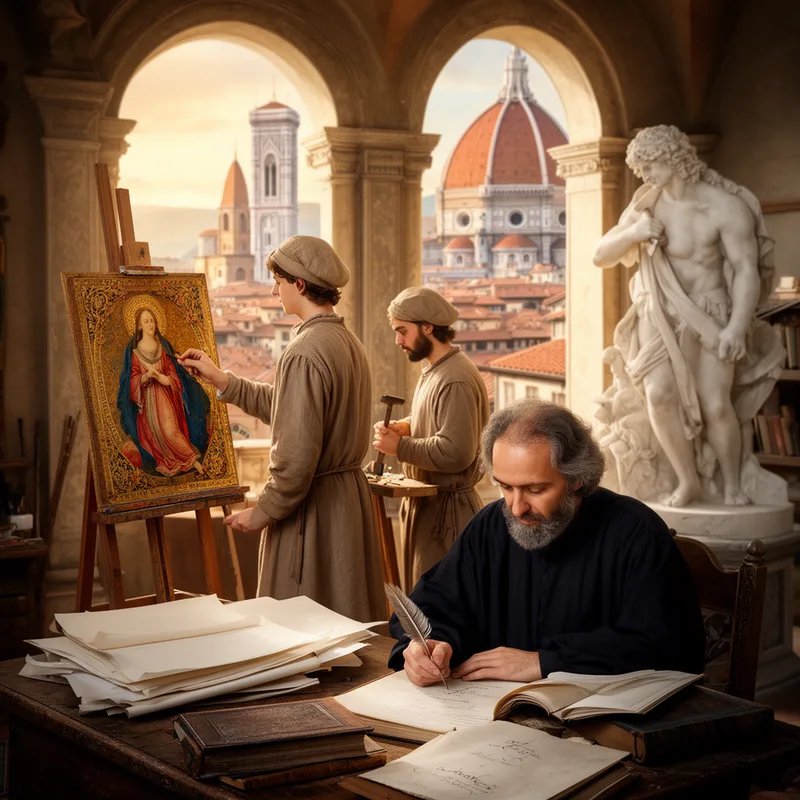
- During the quattrocento, famous works such as Masaccio's paintings emerged, illustrating the advances in perspective and human emotion.
- the late quattrocento
- the early quattrocento
- the Florentine quattrocento
Examples
-
The strong market for paintings that had promoted the prosperity of the workshops in the later quattrocento appears to have continued at least through the second decade of the new century.
Academic text (1998) -
Many historians consider the quattrocento as the foundation of the Italian Renaissance, showcasing significant achievements in art and literature.
-
The unhealthy art of the men of the quattrocento is much more original, more valuable, and more significant.
Academic text (1991) -
The known facts regarding the early quattrocento campaign, based primarily on archival instruments, are few.
Academic text (2015) -
But there is no evidence of an initial contemplation of a second quattrocento sacristy to achieve such symmetry, as has often been anachronistically asserted.
Academic text (2015) -
Thereby, I propose it could be imagined in late quattrocento Florence that the Medicean-Brunelleschian basilica had been conceived and launched in an immaculate imaginary space.
Academic text (2015) -
Filarete seems to have drawn formal inspiration as much from manuscript illustrations such as this as from contemporary or ancient sculpture; indeed, quattrocento courtly painting provides a fundamental clue as to the origins of his unusual style.
Academic text (2012) -
In his splendid book Painting and Experience in Fifteenth-Century Italy, Michael Baxandall argued that the perception and appreciation of quattrocento paintings relied on social experiences, such as dancing or listening to sermons, that the audiences shared with the painter.
Academic text (2012) -
Uccello's descriptive detailing, such as the wood-beamed ceiling and tile floor represented in perspective, as well as the quattrocento dress of his painted figures, also helps to naturalize the host desecration legend in Italy.
Academic text (2003) -
The quattrocento was a period of extraordinary artistic innovation in Italy, leading to masterpieces by renowned artists.
Synonyms
 85
5.8
A period in Europe from the 14th to 17th century with new art, science, and learning
 4
4.7
A period in Italy from the 1300s to the 1600s known for great art and new ideas
Surface Forms
Etymology
Quattrocento comes from Italian quattro 'four' and cento 'hundred', so it names the years 1400–1499 as the 'four hundred' years. Because those years were a rich time for art and literature in Italy, quattrocento now means the 15th century, especially its art and artists.