
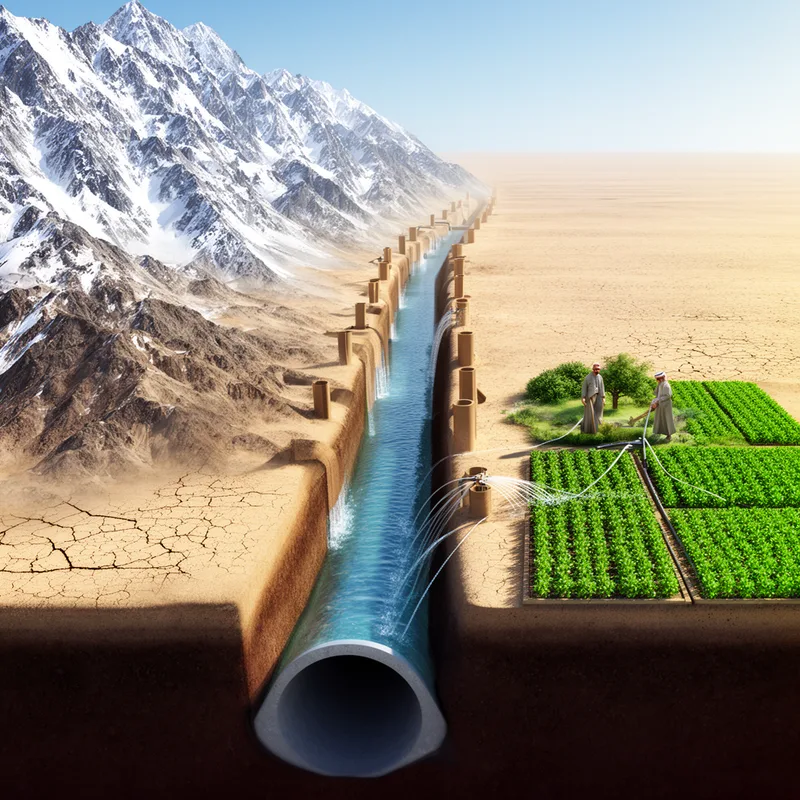
qanat


 1
9.9
- noun
- /ˈkænæt/
- Specialized
- Underground canals called qanats or aflaj, probably constructed during a period of Persian rule about 1000 B.C., according to local archaeologists, tap these aquifers.
- elaborate qanats
- canals called qanats
Examples
-
In the Middle East, particularly Persia, the Muslims perfected the ancient system of qanats, elaborate underground channels that stored water and carried it long distances without danger of evaporation.
Academic text (1994) -
That river periodically vanishes, and farmers depend on underground channels called qanats to transport water.
Academic text (2011) -
Today, these qanats also supply the city of Dubayy, on the coast.
Academic text (1997) -
The qanats made Kharga extremely productive.
Academic text (2008) -
Oil revenues enabled the cementing of the qanats in recent years.
Academic text (1997) -
We have located and mapped several qanats across the Kharga Oasis.
Academic text (2008) -
At Umm el-Dabadib, we explored the qanat's underground tunnels, learning how it felt to be an ancient worker who had to walk hunched over to avoid snakes.
Academic text (2008) -
Using satellite remote sensing data, Vidale has found remains of what might be ancient canals or qanats around Shahdad, but more work is necessary to understand how inhabitants supported themselves in this harsh climate 5,000 years ago, as they still do today.
Academic text (2011) -
Farmers rely on qanats to transport water from underground aquifers to their fields during dry seasons.
-
The ancient city thrived due to its advanced network of qanats, which provided a steady water supply.
Synonyms
 109
6.5
A pipe or channel that carries water, wires and other things
Surface Forms
Etymology
The word qanat comes from Persian and Arabic qanāt, which means 'an underground water tunnel'. These long channels were used to carry water from mountains to dry fields, so today a qanat is an underground channel that brings water for towns and farms.