

pyrexial
- adjective
- /paɪˈrɛk.si.əl/
- Specialized
- On examination, she was pyrexial with a temperature of 39.3°C.
Examples
-
Remember, patients who have non-infective causes for their diarrhoea are much less likely to be pyrexial.
Academic text (2012) -
She remained pyrexial, and chest auscultation revealed bilateral basal crepitations.
Academic text (2007) -
The doctor noted that the patient was pyrexial with a fever of 102°F.
-
During the examination, the nurse confirmed that he was pyrexial at 38.9°C.
-
Feverish and pyrexial, she restlessly tossed in bed as the illness took hold.
Synonyms

 12
3.5
12
3.5

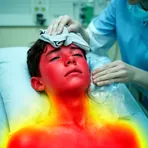
Having a higher than normal body temperature and feeling weak

 1
7.9
1
7.9
Having a much higher body temperature than normal
 1
4.4
1
4.4
Having a high body temperature and feeling hot and weak

Having a body temperature much higher than normal

Having a fever or causing a fever

Has a high body temperature and feels very unwell
Antonyms

How Feverish
- Specialized

- Specialized
- Specialized
4
8.5
- Specialized
1
9.9
Surface Forms
Morphology
pyrexial = pyrexia (semi-transparent) = pyrexi + al
The adjective is formed regularly from the medical noun 'pyrexia' with the suffix '-al', but the base word itself is specialized and unlikely to be familiar to many learners.
Etymology
Pyrexial comes from the Greek root pyr meaning 'fire'. Think of a fever as the body's 'internal fire', so pyrexial means 'having a fever'.