
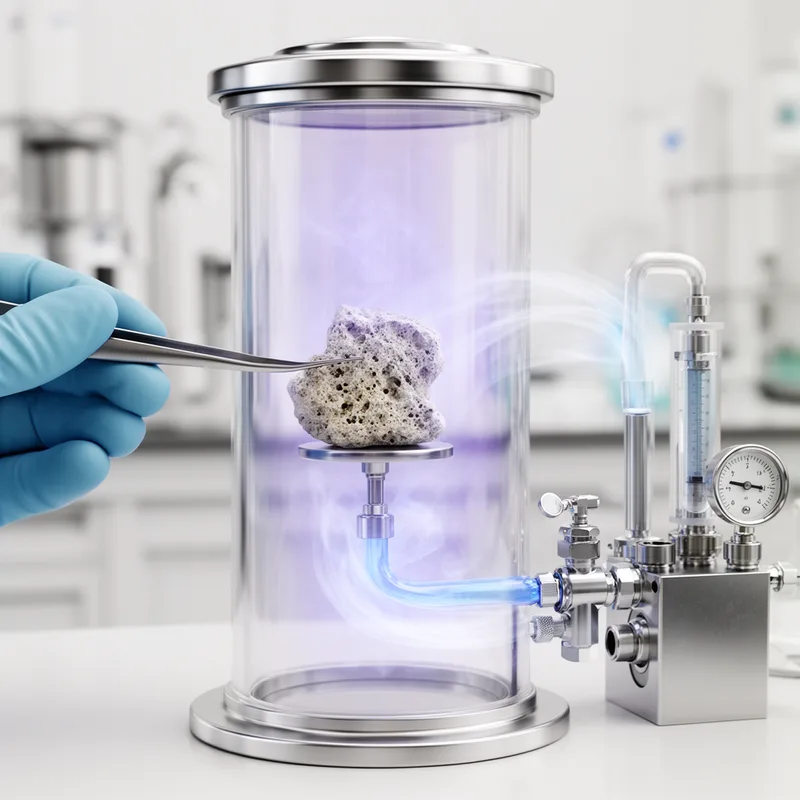
pycnometry
- noun
- /pɪkˈnɒmətri/
- Specialized
- The lab measured the ceramic's skeletal density using pycnometry with helium at controlled temperature.
Examples
-
For porous powders, pycnometry gives the true solid density by measuring displaced gas volume precisely.
-
The lab measured the ceramic's skeletal density using pycnometry with helium at controlled temperature.
-
They compared helium pycnometry results with mercury intrusion data to assess pore structure differences.
-
The lab used pycnometry to measure the density of the new material.
-
The process of pycnometry is essential for accurate density measurements.
-
For porous powders, pycnometry gives the true solid density by measuring displaced gas volume precisely.
-
They compared helium pycnometry results with mercury intrusion data to assess pore structure differences.
Surface Forms
Morphology
pycnometry = pycnometer (opaque) = pycn + metry
As in sense 1, the components are specialist combining forms; the link to density measurement is technical rather than transparent to general learners.
Etymology
Pycnometry comes from the Greek parts pycno- meaning 'dense' and -metry meaning 'measure', like the -metry in thermometer. So, pycnometry is used to find how 'dense' a solid really is, for example by measuring the volume of gas the solid forces out, which is why it is useful for porous materials.

