
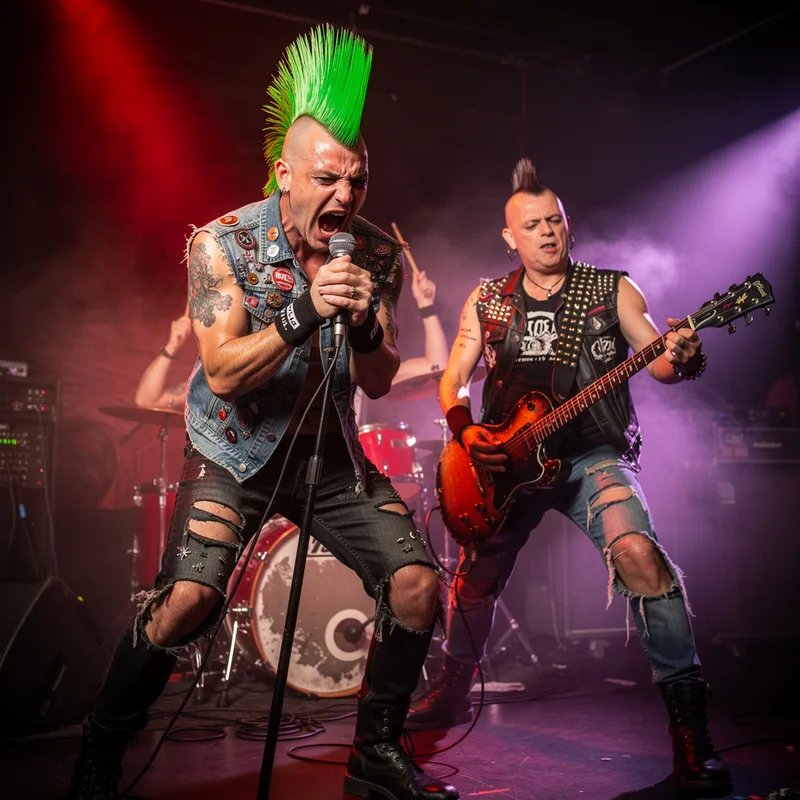
punk band
 8
3.4
8
3.4

- noun
- /pʌŋk bænd/
- He plays in a punk band with his best friends.
- the first punk band
Loading YouTube…
Watch on YouTubeAnd so my next project was a a punk band called The Divinyls from Australia.
- And so my next project was a a punk band called The Divinyls from Australia.
- It popped up and said that he liked your pop punk band.
- They've got an album out with with They've caught me on it punk band.
- But there was an audition where we were auditioning for to play Siamese twins who are The Who are the joint front men of a British punk band.
Examples
-
But I, well, listen to you guys talk about the punk bands that you were in.
-
Wait, you're in a punk band?
-
Were you even in a punk band?
-
"Sounds like a punk band."
Fiction book (1994) -
Who would have thought a punk band wrote this?
Blog text (25) -
I was in an all-girl punk band.
-
- So how's the punk band coming?
-
You're probably in one of those punk bands, right?
-
Northern Ireland gave us Stiff Little Fingers, the great, long-forgotten punk band of the late '70s and early '80s.
Blog text (4) -
He plays in a punk band with his best friends.
Surface Forms
Morphology
The meaning 'a music group that performs punk rock' is directly and transparently derived from combining 'punk' (the musical genre or its participants) with 'band' (an ensemble of musicians); a B1 learner who knows both words can infer the phrase. This noun+noun/attributive pattern is regular in English and cross-linguistically common for naming musical groups, so no special idiomatic knowledge is required.
Etymology
The phrase punk band comes from the word punk, meaning a 'young troublemaker' or 'rebel', and band, a group of musicians. In the 1970s, young groups who played loud, fast music and broke the rules were called 'punks', so a punk band is a group that plays that rough, rebellious style of music.