

punched card


 1
8.4
1
8.4
- noun
- /pʌnʧt kɑrd/
- Archaic
- Before modern digital storage, people used punched cards to record and retrieve data in various industries.
- punched card machine
Examples
-
Brown was still active in 1929 when Leslie J. Comrie in London used Brown's tables and half a million punched cards to compute positions of the Moon through the year 2000.
Academic text (1992) -
Already in the 1880s and '90s, while Brown was working out his theory, American inventor Herman Hollerith was producing punched card machines for tabulating censuses and medical records.
Academic text (1992) -
You gave the punched cards to the operator, and an hour later the operator gave you back your print out.
-
With regard to the computers that count our votes: step back a technical generation to punch cards and simple vote counting programs.
Blog text (5) -
It required the efficient configuration of punched cards and the machines to read them, developed by IBM and UNIVAC in the United States.
Academic text (2017) -
During this time, Herman Hollerith developed the first system of coding data on punched cards, and his Tabulating Machine Company later became what is now IBM.
Academic text (2002) -
A precursor of the computer, this technology included the sorting, classifying, analysis, and reporting of large amounts of data using punched cards and machines carrying out various operations using these cards.
Academic text (2003) -
In the early days of computing, data was often stored on punched cards that contained patterns of holes.
-
Many historic computer systems relied on punched cards to process information and generate outputs.
Synonyms
 11
7.4
11
7.4
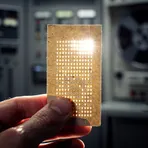
A stiff card with holes that show information used by old computers
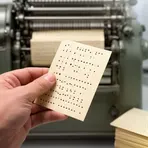
A stiff paper card with holes used to record information for early computers
Surface Forms
Morphology
punch + card
The meaning is directly and transparently derived from 'punch' (to make holes) + 'card' (a piece of stiff material); a B1 learner who knows those words can infer it is a card with holes. The past-participle modifier 'punched' signals 'having been pierced,' and this compositional pattern is ordinary and predictable, so the expression is transparent.
Etymology
The term punched card comes from old machines that kept information as holes punched in a thick card. A machine made the holes to show 'data' or 'programs', so punched card means a stiff card with patterns of holes used to store information.