

to pull along
 10
3.0

- phrasal verb
- /pʊl əˈlɔŋ/
- He struggled to pull along the heavy suitcase up the steep hill.
- pull the suitcase along
- pulled it along the ground
- pulled along by a rope
Loading YouTube…
Watch on YouTubeWe lay down, I pull the security along this long road and the town starts to wake up and I'm just getting these bad vibes.
- We lay down, I pull the security along this long road and the town starts to wake up and I'm just getting these bad vibes.
Examples
-
The servant lost his patience and began to pull him along by the armpits.
Fiction book (1990) -
So the only vendors you're going to see now are a few like the man over there who's pulling his goods along the sand because the law requires that you have to keep moving.
-
The balls quickly come together in our wake and some close to the motor are pulled along with the boat.
-
But once again, she felt herself being pulled along by Josh's excitement.
Fiction book (1993) -
Her sister Rachel shook her awake and pulled her along to stand with her older sisters.
Fiction book (1997) -
"We have to hurry, Garth," Lindsay said and pulled him along.
Fiction book (1995) -
Gordon Washbaugh shouted at her, pulling her along as her other friends tried to follow.
Fiction book (1997) -
I stumbled down the stairs, her arm pulling me along the crescent-shaped wall of the theater.
Fiction book (1997) -
Move, move, move!" When Delores hesitated, Aur grabbed her arm and pulled her along.
Fiction book (1998) -
Charlie grabs the rack and jerks it down into the street, pulling the gunman along with it.
Fiction book (1991)
Synonyms
 ∞
1.0
To move something toward you using force, often to remove it
 172
4.1
To pull something suddenly and hard
 124
2.0
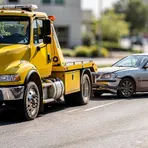
To pull a vehicle behind another using a rope or chain
 95
1.0
To pull something hard, often in a quick way
 79
2.5
To pull something with effort, often slowly
 48
4.4
To carry or drag something heavy with effort
 32
2.3
To carry something, often heavy, from one place to another
 16
9.9
To carry something heavy or awkward with effort
 1
9.9
To carry or pull something with effort when it is heavy


 1
3.8
To pull something behind a vehicle for transport
Antonyms


How Hard

Surface Forms
Morphology
The meaning 'to move something by dragging or hauling it' is directly and transparently derived from combining 'pull' (apply force to bring something closer) with 'along' (in a direction or following a length), following a standard English verb+particle motion pattern. This compositional pattern is cross-linguistically common and predictable, so a B1 learner who knows the constituent words will readily infer the MWE meaning.
Etymology
Pull along comes from the simple picture of someone using force to drag a heavy thing forward, like a person pulling a cart along a road or a suitcase along the pavement. That's why it means 'to move something by dragging or hauling it' with effort.