
psychosomatics


 1
7.2
- noun
- /ˌsaɪkoʊsəˈmætɪks/
- Specialized
- Probably the first scientific roots for guided imagery in relation to health delivery may be found in the early work of Franz Alexander, the father of psychosomatics, and the Director of the Institute for Psychoanalysis, when he maintained that the new kind of health problem was "holistic" in nature (Seem, 1987).
Examples
-
Franz Alexander, the father of the study of psychosomatics and the Director of the Institute for Psychoanalysis, defined the new kind of health problem as "holistic" in nature (Seem, 1987).
Academic text (1990) -
Many of us are now exploring the therapeutic relationship in different ways, in light of other medical cultures; we are learning how to incorporate participation, psychosomatics, and bio-psycho-social holism.
Academic text (2001) -
Psychosomatics, 44(3), 209-215.
Academic text (2003) -
The progress in discovering the extent of self-regulatory influences on physiological well-being has opened the way to a shift away from passive models of physiological events to active agency models of behavior and psychosomatics.
Academic text (1995) -
Azhar, M. Z., & Varma, S. L. (1995b). Religious psychotherapy in depressive patients. Psychotherapy and Psychosomatics, 63, 165-168.
Academic text (2011) -
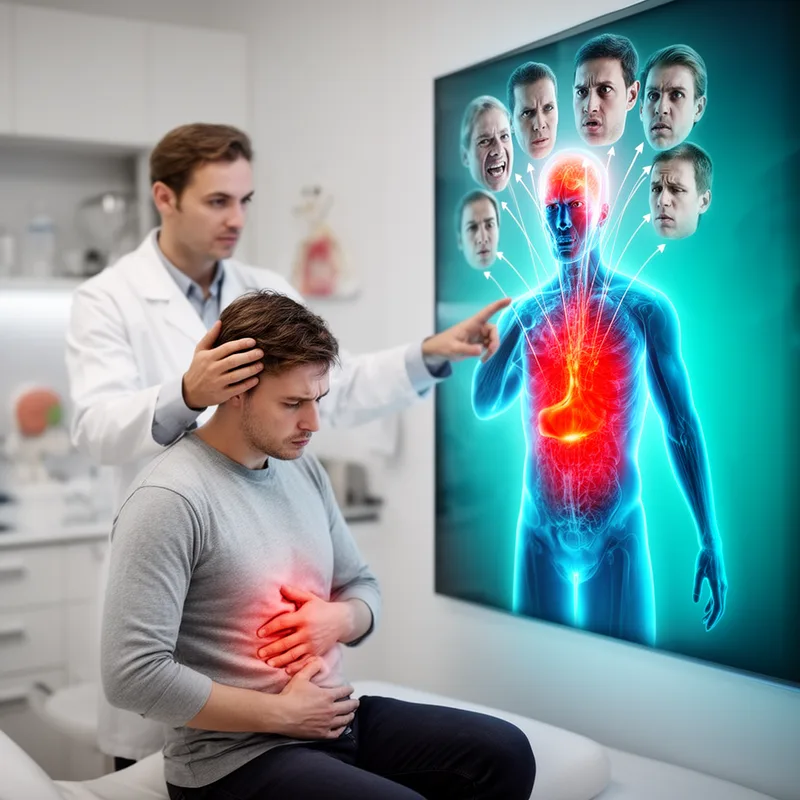
Psychosomatics explores how stress and anxiety can lead to physical symptoms in the body.
-
The field of psychosomatics examines the connection between mental health and physical illness.
-
Understanding psychosomatics can help doctors consider emotional factors when diagnosing physical conditions.
Synonyms
 1
9.9
The study of how the mind and body affect each other
Surface Forms
Morphology
psychosomatics = psychosomatic (opaque) = psycho + somat + ic + s
The immediate base is a technical adjective, and adding -s to form the field term is not likely to be inferable for an average B1 learner.
Etymology
Psychosomatics comes from the Greek parts psyche ('mind') and soma ('body') plus the ending -ics ('study of'). So it literally means the study of how the mind and body affect each other, which is why psychosomatics looks at how emotions and stress can cause real physical symptoms.