
protostome


 1
9.9
- noun
- /ˈproʊtəˌstoʊm/
- Specialized
- Other similarities, like DNA sequences, indicate that priapulids are closely related to protostomes.
Examples
-
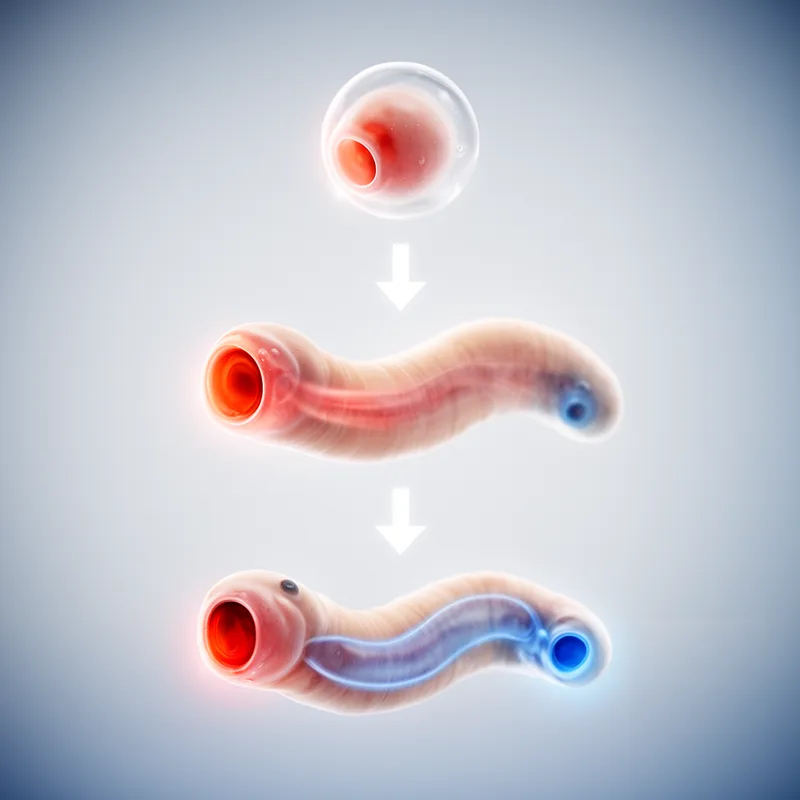
During embryonic development, a protostome is characterized by the formation of its mouth before its anus.
-
Molecular techniques that have used the analysis of gene expression have revealed that a primitive protostome, Priapus caudatus, develops like a deuterostome.
Blog text (4) -
There might be a need to rename the protostome class of animals.
Blog text (4) -
This is not the first report of a maverick protostome.
Blog text (4) -
This suggests that early protostomes developed differently.
Blog text (4) -
The protostomes formed their mouth first, the anus second.
Blog text (4) -
Protostomes have historically been defined by the order in which they develop a mouth and an anus as embryos.
Blog text (4) -
Difference is protostomes have the the mouth opens first in the digestive tract and the anus opens last.
-
Because deuterostomes and protostomes differ fundamentally in the way in which their eggs undergo cleavage, they probably took separate evolutionary pathways hundreds of millions of years ago, suggesting only the most tenuous relationship between the two groups.
Academic text (1997) -
Arthropods are protostomes and vertebrates are deuterostomes, and the twain last met so long ago that all anatomical signs of a shared and distant past should be effaced by subsequent evolution.
Academic text (1992)
Surface Forms
Morphology
protostome = proto + stome
The term is built from the classical element proto- meaning 'first' and the bound form stome meaning 'mouth/opening', but the second element is not a common standalone English word, so the meaning is not straightforward for typical learners.
Etymology
Protostome is formed from Greek parts proto- 'first' and -stome 'mouth', like the proto- in prototype, so a protostome is an animal whose mouth develops before its anus during early development.