
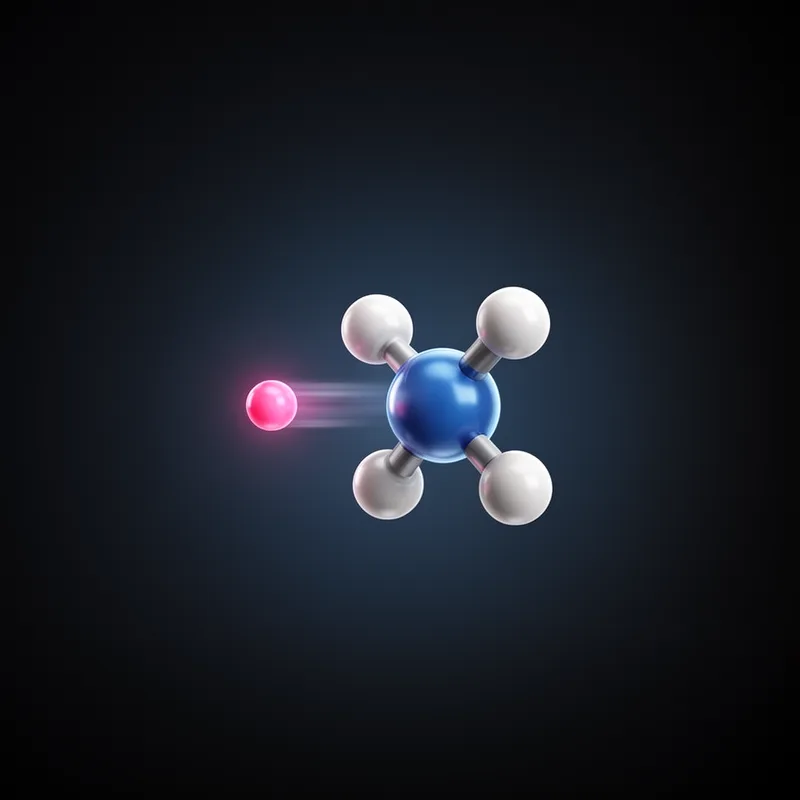
to protonate


 1
8.6
- verb
- /ˈproʊtəˌneɪt/
- Specialized
- But if you put HBR in there, you protonate it, right?
Examples
-
In the presence of acid, the compound can protonate and form a positively charged ion.
-
So it's able then to to protonate this, this this.
-
An initial rapid protonation of the ketal is followed by the reaction of the protonated species with water to form a hemiketal and an alcohol.
Academic text (2001) -
The intermediate U is believed to be a protonated tryptophan radical 1(b).
Academic text (2001) -
PEI possesses the native positive charge due to the protonated amine groups at the neutral pH of 7.0.
Academic text (2018) -
The carbocation releases a proton (the last step), which then protonates another ester group to repeat the last three steps of this sequence.
Academic text (2001) -
We recently applied IMOMO to the S1 photoisomerization of the retinal protonated Schiff base (PSB) 64.
Academic text (2001) -
To increase the reactivity, they decided to protonate the molecule during the experiment.
-
When water is added to the solution, it can protonate the organic compound effectively.
Surface Forms
Morphology
Etymology
Protonate comes from proton, a small, positively charged particle inside atoms, and the verb ending -ate which can mean 'to give' or 'to make'. So to protonate is to 'give' a proton to a molecule, and that added positive particle changes the molecule's properties.