
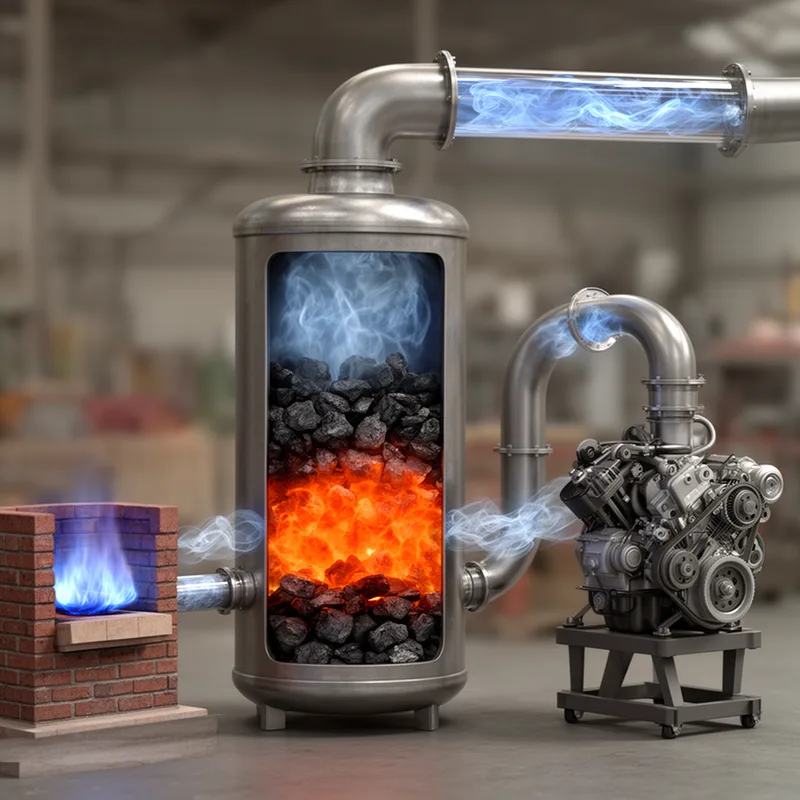
producer gas
- noun
- /prəˈduːsər ɡæs/
- Archaic
- Early automobiles sometimes ran on producer gas when petrol was scarce.
Examples
-
The factory used producer gas as an energy source during the power outage.
-
Engineers improved the efficiency of producer gas for industrial heating applications.
-
The factory uses producer gas for heating.
-
Many industries rely on producer gas as a fuel source.
-
During the energy crisis, some households switched to producer gas for heating their homes.
-
The process of creating producer gas involves heating coke with air to generate a combustible gas.
-
For their operations, the plant depended on producer gas as a cost-effective alternative to natural gas.
Synonyms
A gas produced by passing air over hot coal and used in the past for lighting and heating

A gas that forms when steam passes over hot coal and burns as a fuel in industry

A gas made of hydrogen and carbon monoxide used as fuel or to make chemicals
Surface Forms
Morphology
The phrase is compositionally built — a B1 learner who knows 'producer' (one that produces) and 'gas' can infer it denotes a type of gas that is produced or generated. However, the precise technical sense (a specific CO/H2/N2 fuel gas produced by passing air over hot coke) and production process are specialized and not predictable from the constituents alone, so it is only partly transparent.
Etymology
The noun producer gas comes from a simple picture: a machine called a producer makes a gas by blowing air over hot coal, so the coal gives off a gas you can burn. So the name came to mean the gas made this way and used as 'fuel'.

