
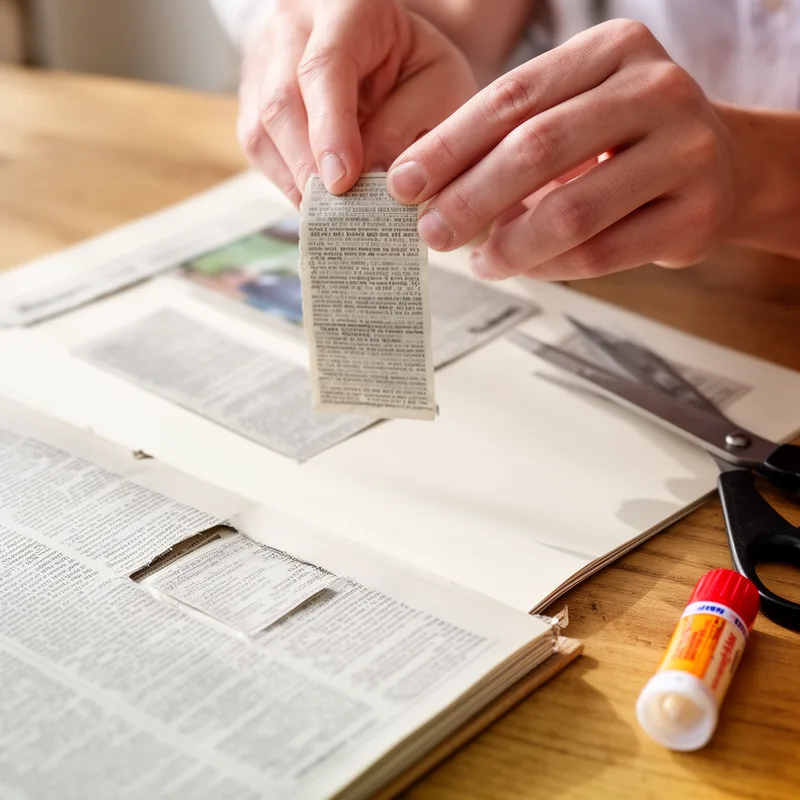
press cutting
- noun
- Literature
- The first is full of press cuttings and some gruesome-looking snaps.
Loading YouTube…
Watch on YouTubeAbout four weeks into the show, somebody said, oh, we've got the first press cuttings.
- About four weeks into the show, somebody said, oh, we've got the first press cuttings.
- And then we can say the same of the press cuttings and the other notes.
Examples
-
She keeps all her press cuttings in a scrapbook for future reference.
-
And then we can say the same of the press cuttings and the other notes.
-
I read your press cuttings.
-
So I put this whole package together with an audition tape and all my press cuttings and the fact I've done radio in England and in Austria.
-
Jurina picks up the story as he leafs through bulging files of press cuttings covering the dig.
Academic text (2005) -
And while you're storming Moscow, Napoleon, I suppose I'm expected to sit at home, like Josephine, saving your press cuttings and knitting your mittens.
-
I found an old press cutting about the town's history while cleaning the attic.
-
The journalist reviewed her press cuttings to gather information for her book.
Synonyms

 69
3.5
69
3.5

A small piece taken from something larger, like a newspaper article or plant for growing
 42
1.9
42
1.9
A small piece cut from a newspaper containing an article or photo
 11
2.3
11
2.3
A small piece cut from a newspaper that people keep to remember something
 3
3.2
3
3.2
A short article cut from a newspaper or magazine kept for reference
Surface Forms
Morphology
The meaning 'an article or piece cut out from a newspaper' is directly derivable from combining 'press' (newspapers/journalists) with 'cutting' (a piece removed or kept). This is a straightforward compositional noun phrase (often realised as 'press cutting' or 'press clipping') and follows common patterns found in many languages, so a B1 learner who knows both constituents will readily understand it.
Etymology
Press cutting may come from the old habit of cutting a story out of a paper made by the printing press. The cutting (the piece people cut out) was kept as a 'record', so the phrase now means 'an article cut out and saved'.