

prairie coneflower
- noun
- /ˈprɛəri ˈkoʊnˌflaʊər/
- US
- Gardeners often plant prairie coneflowers to attract bees and butterflies.
Examples
-
The prairie coneflower blooms beautifully in summer meadows across North America.
-
The prairie coneflower blooms in late summer.
-
We spotted a cluster of prairie coneflower along the hiking trail in New Mexico.
-
Many prairie coneflowers grow in the wild.
-
The bright yellow petals of the prairie coneflower attract many pollinators in the summer.
-
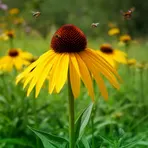
In the meadow, the prairie coneflower stands tall among other wildflowers, displaying its cone-shaped center.
-
Gardeners in North America often choose the prairie coneflower for its beautiful blooms and resilience in dry soil.
Synonyms
 1
7.1
1
7.1

A North American wildflower with a cone-shaped center and long petals around it

A tall North American wildflower with a central cone and drooping yellow or red petals
Surface Forms
Morphology
This is a straightforward noun–noun compound where 'prairie' specifies the habitat or variety of 'coneflower', so a learner who knows both words can infer it is a coneflower that grows on prairies. The compositional pattern (type/location modifier + noun) is common across languages, making the meaning directly derivable from the parts.
Etymology
Prairie coneflower names a wild flower that grows on the open prairie and has hanging petals with a raised cone in the center. The clear image of a raised cone in the middle of a prairie flower makes the name easy to remember and explains why we use it for this North American meadow plant.