
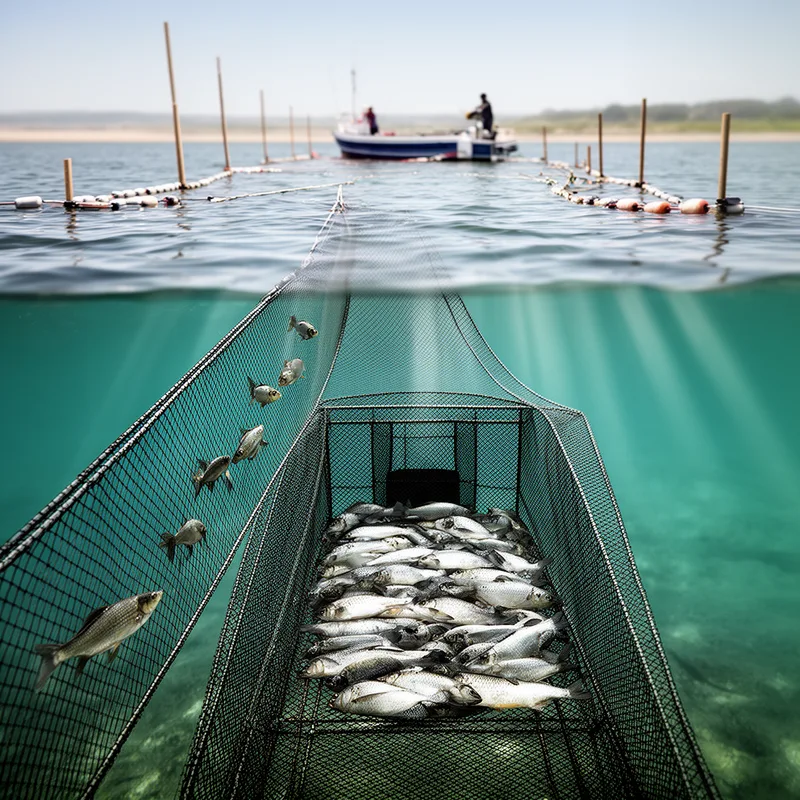
pound net
- noun
- /paʊnd nɛt/
- Specialized
- The fishermen checked their pound net every morning to see the day's catch.
- pound nets installed
- pound-net crew
- Pound nets caught
Examples
-
During the summer, many species of fish are captured in pound nets along the coast.
-
Before the late 1940s, pound nets were made of cotton twine.
Academic text (1990) -
In recent years, all pound nets have been installed for the entire season.
Academic text (1990) -
" Afterwards, it worked for me to set and tend pound nets.
Fiction book (1997) -
Fishing crews had two sets of nets for each of their pound nets; one was installed in the bay.
Academic text (1990) -
Owners of pleasure boats view the pound nets as a hazard to boating.
Academic text (1990) -
The composition of fish caught in pound nets varied seasonally.
Academic text (1990) -
The average catch per pound net was 48,450 pounds of food fish, for a total of 484,500 pounds.
Academic text (1990) -
In the first few decades that pound nets were installed, sportfishermen encouraged politicians to have them banned.
Academic text (1990) -
In 1855, George Snediker of Gravesend, Long Island, introduced pound nets to New Jersey.
Academic text (1990)
How Big


Surface Forms
Morphology
The compound combines 'pound' (an enclosure) with 'net' (a catching mesh), so the sense 'a net forming an enclosure to trap fish' is directly derivable from the constituents. Although the term is somewhat specialized to fishing, its noun+noun compositional structure is straightforward and would be understandable to a B1 learner who knows both words.
Etymology
Pound net comes from the idea of a pound, a small 'pen' or enclosure, plus net. Fishermen set nets to guide fish into a fenced area where they cannot swim back out, so the name means 'a large fishing trap'.