
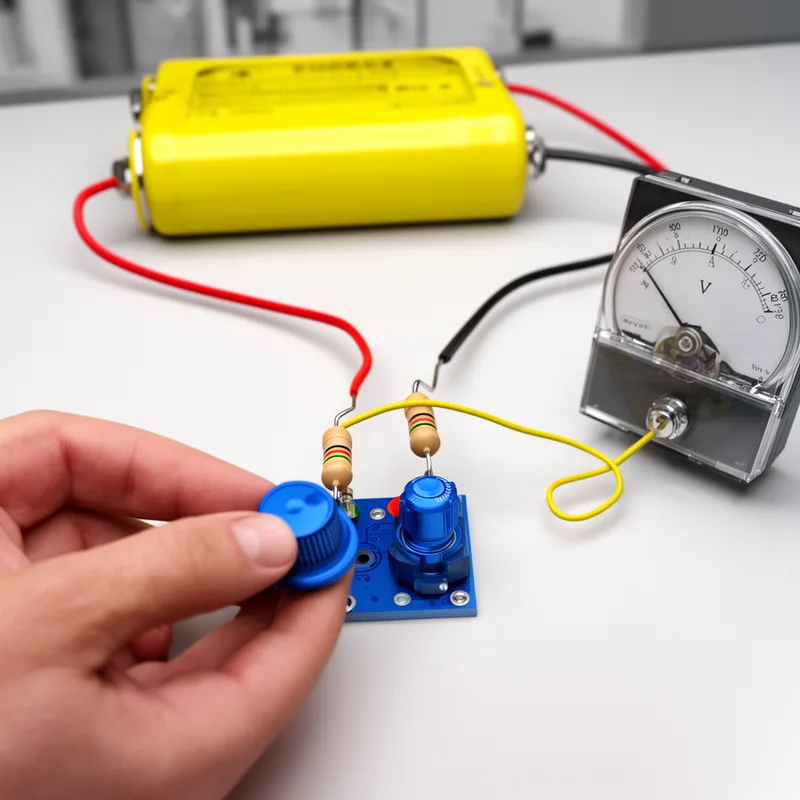
potential divider
- noun
- /pəˈtɛnʃəl dɪˈvaɪdər/
- UK
- By adjusting the resistances in a potential divider, you can control the output voltage.
Examples
-
A potential divider is commonly used to generate reference voltages in electronic circuits.
-
The sensor was connected as part of a potential divider to measure changing resistance.
-
A potential divider can be used to reduce voltage.
-
This potential divider is essential for the circuit.
-
A potential divider is an essential component used in electronic circuits to generate specific voltage levels.
-
In a potential divider, the output voltage can be adjusted by changing the values of the resistors in series.
-
Using a potential divider allows engineers to produce a fraction of the input voltage for various circuit applications.
Synonyms

A set of resistors connected in a line across a battery or power supply that gives a smaller output voltage
Surface Forms
Morphology
The noun is compositionally transparent: it denotes a device that 'divides' electrical 'potential' (voltage). Assuming the learner understands 'potential' as electrical potential/voltage and 'divider' as something that partitions, the meaning (a circuit arrangement producing a fraction of a voltage) is directly inferable despite its technical context.
Etymology
The term potential divider comes from the simple idea of splitting electric potential — the 'push' that moves electricity — across parts so the push is shared. Think of people sharing a cake so each person gets a piece: that's why a potential divider is a set of parts used to make a smaller 'voltage' from a larger one.

