
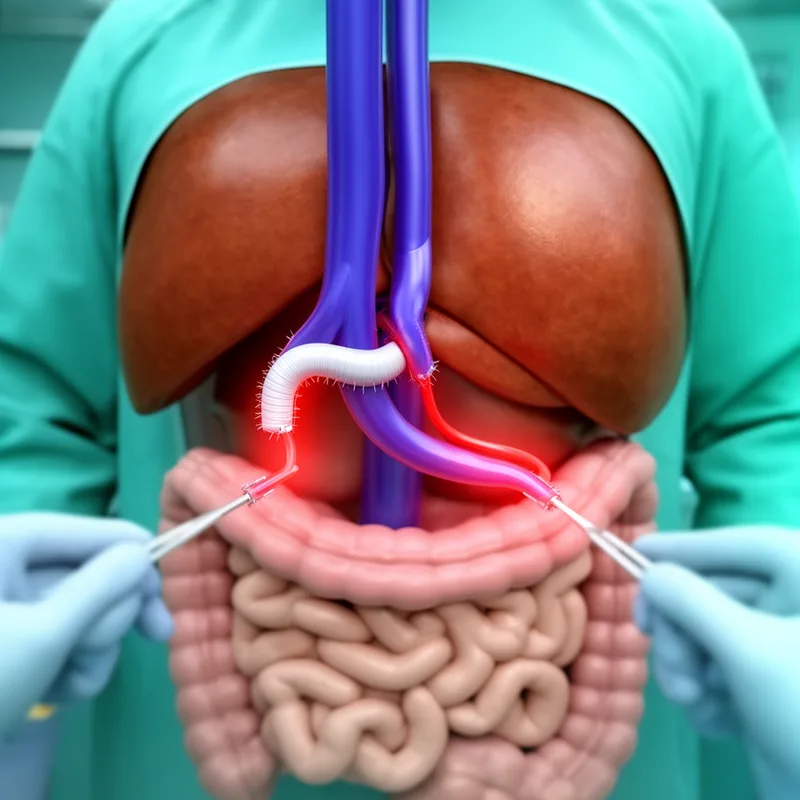
portacaval shunt


 1
7.9
1
7.9
- noun
- /ˌpɔrtəˈkeɪvəl ʃʌnt/
- Specialized
- Complications can arise after a portacaval shunt, so patients require careful monitoring.
Examples
-
The surgeon performed a portacaval shunt to alleviate the patient's portal hypertension.
-
The doctor performed a portacaval shunt to alleviate pressure in the portal vein.
-
A portacaval shunt is sometimes used when liver transplantation is not an option.
-
A portacaval shunt can help patients with liver cirrhosis.
-
The surgeon explained that a portacaval shunt would help reduce pressure in the patient's portal vein.
-
After the portacaval shunt procedure, blood can flow directly to the inferior vena cava.
-
Doctors often recommend a portacaval shunt for patients with severe liver complications.
Synonyms
 13
7.8
13
7.8
A tube that moves fluid from one part of the body to another

A tube surgeons use to carry blood around a blocked or damaged vessel
Surface Forms
Morphology
portacaval + shunt
This is a highly technical medical compound: 'portacaval' is a specialized combining form referring to the portal vein and the vena cava and is not a common lexical item a B1 learner would know. Even if a learner knows 'shunt' as a diversion, they would not be able to derive the specific anatomical meaning (a surgical connection between portal vein and inferior vena cava) from the constituents, so the expression is not transparently interpretable.
Etymology
Portacaval shunt comes from its parts: porta, the vein from the gut, caval, the large vein to the heart, and shunt, a new passage. Imagine joining two rivers with a small canal so water can 'bypass' a lake; a portacaval shunt lets blood 'bypass the liver', which is why the name describes this surgical passage.