
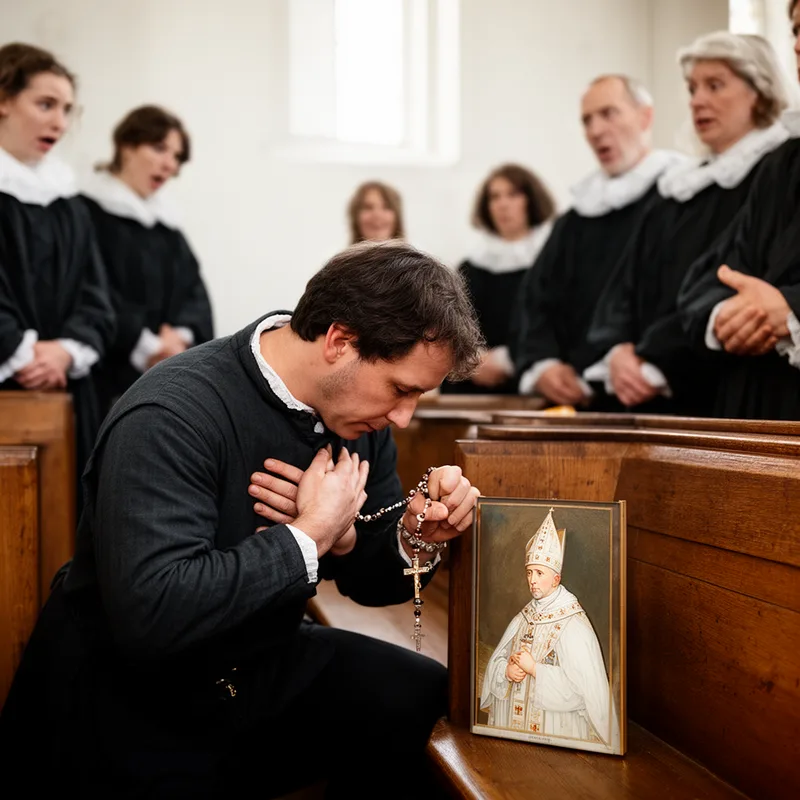
popish behavior
- noun
- Slur
- In 17th-century England, accusations of popish behavior could damage one’s reputation.
Examples
-
Pamphlets of the era warned against adopting any popish behavior in public life.
-
His popish behavior at the ceremony did not go unnoticed by the Protestant congregation.
-
The critics accused him of popish behavior during the debate.
-
Many viewed her popish behavior as outdated.
-
In the 1600s, many feared that exhibiting popish behavior would lead to persecution by the authorities.
-
After the reforms, some still exhibited popish behavior, drawing criticism from more radical Protestants.
-
Historical records indicate that accusations of popish behavior often incited riots in certain communities.
How Catholic


Surface Forms
Morphology
The adjective 'popish' denotes something relating to the Pope or Catholic practices, and combined with 'behavior' this yields a straightforward meaning: behavior characteristic of Catholics. Although 'popish' can be archaic or derogatory in tone, the overall sense is compositionally predictable and therefore accessible to a B1 learner who knows both constituents.
Etymology
Popish behavior comes from a time when people who did not follow the 'Pope' called actions that seemed 'like the Pope' popish. Calling someone's actions popish behavior was a way to show dislike, so today it means behavior typical of a follower of the 'Pope', often used as an insult.