
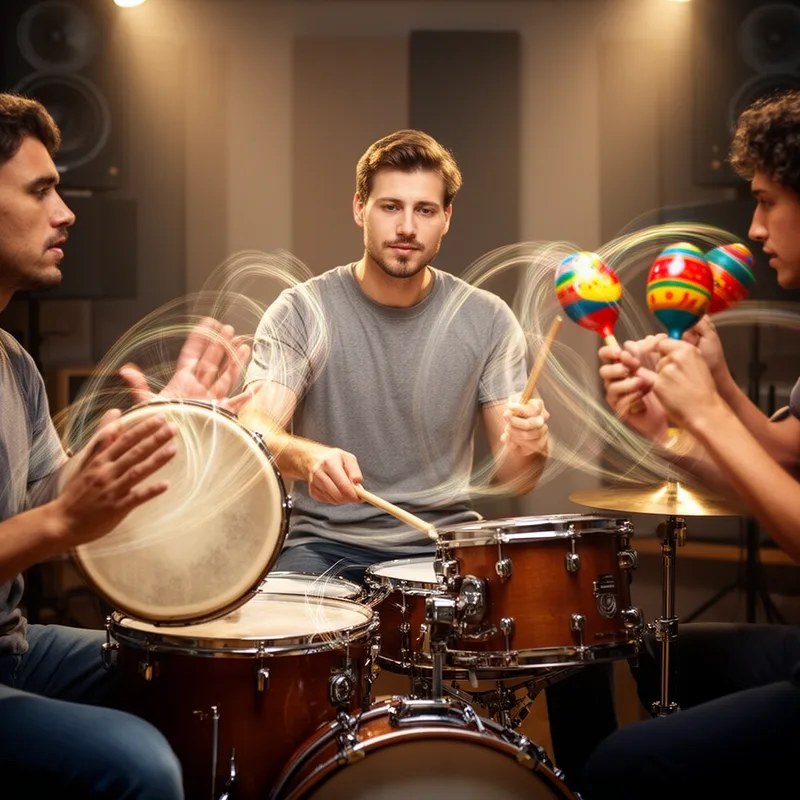
polyrhythmic
 1
7.9

- adjective
- /ˌpɒliˈrɪðmɪk/
- Specialized
- The drummer created a polyrhythmic beat that added complexity to the song.
Examples
-
Afterward, each group was given a set of drums, and the ethnomusicologist taught one student to play a bell pattern, a cyclical rhythm that alternately aligns with the by 2 and by 3 patterns, which increases the polyrhythmic tension.
Academic text (2015) -
Using the "overdub" feature, students can add more rhythmic ostinati to produce relatively thick, polyrhythmic percussion parts.
Academic text (1995) -
The lesson plans, as Rice says, explore the polyrhythmic patterns of Gullah music.
Academic text (2011) -
Group 8 constructed a polyrhythmic piece inspired by blues and jazz fiddling.
Academic text (2015) -
But the rhythm is often polyrhythmic because many African musicians can respond to numerous rhythms at the same time.
Academic text (1995) -
Individual group members work together to create vocal ostinato lines that complement each other and are layered to produce a polyrhythmic effect.
Academic text (2003) -
A student playing rhythm patterns might receive a one for playing a familiar rhythm pattern to a steady beat, while a student playing a familiar pattern over a polyrhythmic background would receive a five.
Academic text (2012) -
When using odd-numbered cycles, the vocal part will formulate into a polyrhythmic cross-rhythm against the pulse.
Academic text (2013) -
This polyrhythmic setting of solkattu is one Western representation of the rhythmic tension that can be created by Indian performers in tala.
Academic text (2013) -
Educators can use a polyrhythmic metronome tool such as those on bouncemetronome.com to illustrate this multileveled approach to rhythm.
Academic text (2015)
How Complex

Surface Forms
Morphology
Etymology
The word polyrhythmic comes from the prefix poly- meaning 'many', as in polygon, and the word rhythm meaning 'beat'. So polyrhythmic music has 'many' different beats at the same time, creating a rich, layered sound.