
polyimide


 1
8.4
- noun
- /ˌpɒliˈaɪmɪd/
- Specialized
- A thick layer is used to enhance the photoresist and polyimide adhesion.
- polyimide adhesion
- polyimide layer
- polyimide dielectric
Examples
-
The critical wiring, which consists of five levels of copper lines with a polyimide dielectric, is deposited on top of this base.
Academic text (1998) -
The Cu layer is then planarized to the polyimide surface using a proprietary procedure.
Academic text (1998) -
The depth of the affected areas could be as much as half of the polyimide thickness.
Academic text (1998) -
The topography in the polyimide above the metal features was removed in the initial stages of polishing.
Academic text (1998) -
The first polyimide layer, one of whose functions is to planarize the substrate surface, is then applied.
Academic text (1998) -
After blanket polyimide deposition, vias are opened in the polyimide.
Academic text (1998) -
For all levels except the first, the starting surface was the planarized polyimide surface of the preceding level with flush, exposed vias.
Academic text (1998) -
The use of less-reactive polyimide dielectrics to make the cupping layer unnecessary is currently under development.
Academic text (1998) -
Nonplanar structures can create localized variations in polyimide thicknesses.
Academic text (1998) -
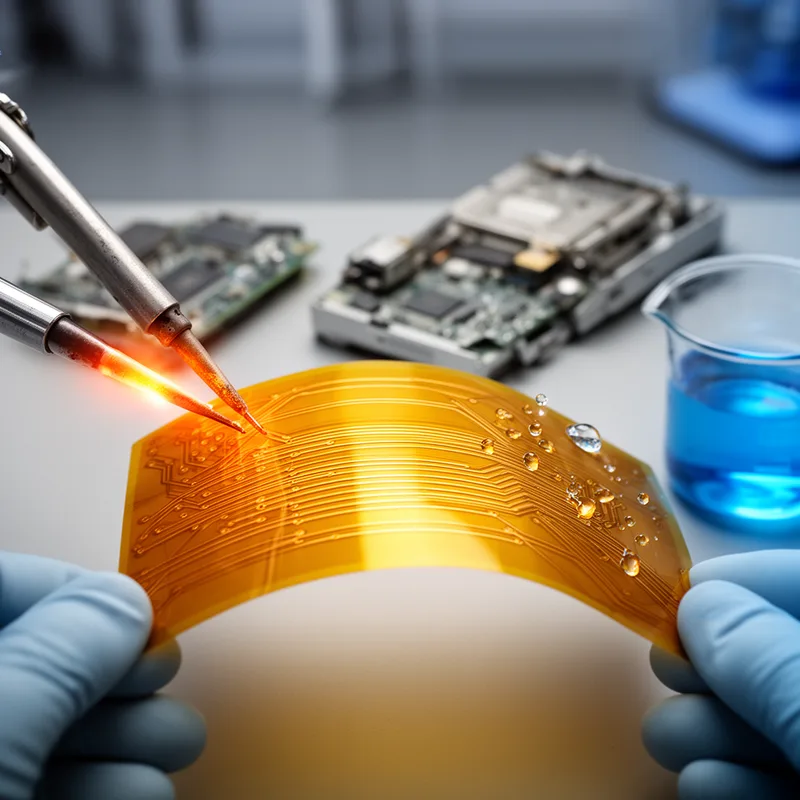
Polyimide is commonly used in electronics due to its high thermal stability and resistance to chemicals.
Surface Forms
Morphology
Etymology
Polyimide starts with poly- ('many') and ends with -imide (a chemical ending for a strong, heat-resistant part). So, polyimide is a material made of many repeating strong parts, which is why it is very heat resistant and used in electronics and industry.