
polyandry


 1
9.9
1
9.9
- noun
- /ˌpɑːliˈændri/
- In some cultures, polyandry allows a woman to marry multiple husbands at once.
- polyandry—one woman
Loading YouTube…
Watch on YouTubeIt could be one man, multiple women, which is called polygyny, or it could be one woman, multiple men, which is called polyandry.
- It could be one man, multiple women, which is called polygyny, or it could be one woman, multiple men, which is called polyandry.
Examples
-
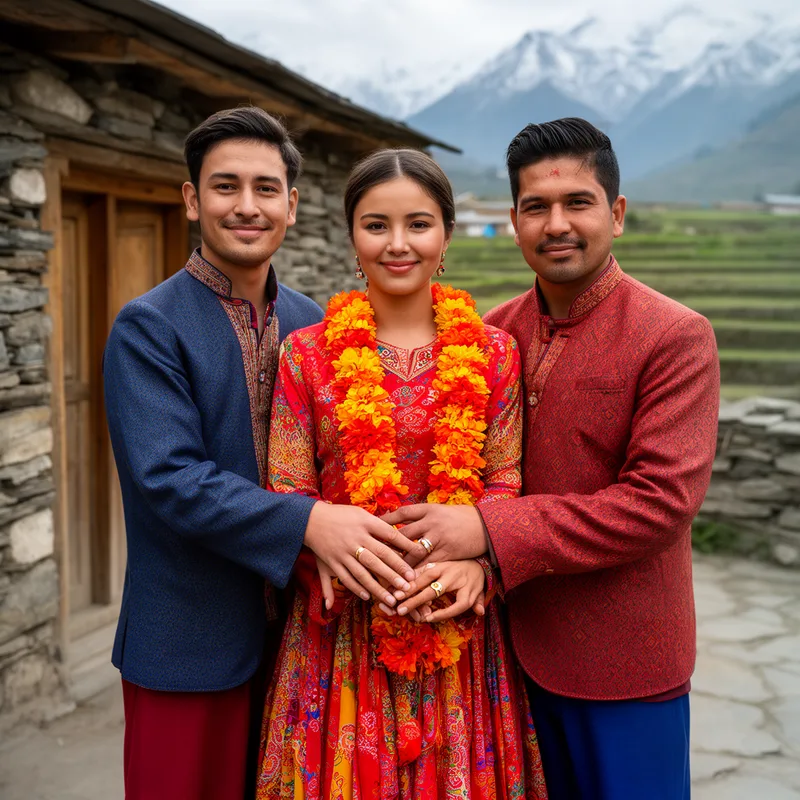
Polyandry has been fairly rare, practiced primarily in the Himalayan regions of Nepal, Tibet, India, and Bhutan.
Academic text (2011) -
And in Waitangi, polyandry is especially likely because of the biased sex ratio.
Academic text (1993) -
Hey, is there any polyandry going on with humans?
-
But not until a hundred years later was the existence of polyandry documented.
Academic text (1995) -
Fraternal polyandry occurs when multiple brothers share a common wife.
Academic text (2011) -
Sometimes, two male twins married the same woman, representing a rare example of polyandry (Dieterlen 1950:87, Imperato 1975).
Academic text (2008) -
Polygamy is often confused with polygyny—the union of one man with several wives—but polygamy also includes polyandry—one woman with several husbands.
Academic text (2011) -
Fraternal polyandry is a unique family arrangement where brothers share a single wife.
-
Anthropologists study polyandry to understand its role in certain societies with scarce resources.
Synonyms
 28
7.2
28
7.2
A marriage in which a person has more than one husband or wife at the same time
Antonyms

How Monogamous
38
4.3
 1
9.9
1
9.9
Surface Forms
Morphology
polyandry = poly + andr + y
Although the word contains the classical elements poly- 'many' and andr- 'man/husband', this is a learned term whose meaning is not readily recoverable for an average English learner from standard English morphology.
Etymology
Polyandry comes from the Greek parts poly- meaning 'many' and -andry meaning 'man', the same root you see in android. So polyandry literally means 'many men', which explains why it names the practice of having more than one husband at the same time.