

poison ivy
 3
4.1
3
4.1

- noun
- /ˈpɔɪzən ˈaɪvi/
- US
- My long sleeves in the one-hundred-degree days keep anyone from seeing the seeping crust of poison ivy, a remnant of a day in the woods with Graham.
- poison ivy rash
- case of poison ivy
- get poison ivy
Examples
-
Terrible itching and throbbing inside my right ear; once in grade school, I was almost crazy with it, desperately poking a sharp pencil inside my ear. The teacher grabbed my hand and took me to the nurse, and she said, "My God, you've got poison ivy inside your ear."
Fiction book (1996) -
Two weeks ago, I developed a lovely case of what we determined to be poison ivy.
Blog text (17) -
James sees that Henry is fidgeting and scratching his poison ivy.
Fiction book (1990) -
The summer she married Teddy, she had picked some wildflowers and come down with the ugliest case of poison ivy ever.
Fiction book (1990) -
The summer before her senior year of high school, Lee White contracted a vicious case of poison ivy when she ran up the hill behind her house to spy on Jazz Taylor playing tennis with his mother.
Fiction book (1996) -
I had a case of poison ivy that looked like leprosy, and everyone was mad because I was supposed to wear pink tulle in the wedding to be a lady, even though I'd only recently come down out of the trees.
Academic text (1991) -
"Last summer, I developed a rash after touching poison ivy while hiking in the woods."
-
"The doctor confirmed that my rash was caused by poison ivy and recommended a soothing cream."
-
"To avoid poison ivy, it's important to learn how to identify the plant when you're outdoors."
Synonyms
 128
2.7
128
2.7
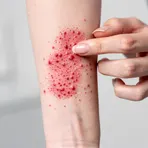
A group of red spots on the skin caused by illness or allergy
 5
5.0
5
5.0
Skin that becomes red, itchy and sometimes has blisters or a rash
 4
3.0
4
3.0
A red, itchy area on the skin that may have spots or bumps
 3
3.0
3
3.0
Red, itchy or sore skin after touching something that causes a reaction


 1
6.1
1
6.1
A skin rash caused by touching the plant's oil

A skin rash you get from touching plants like poison ivy or poison oak
How Severe

Surface Forms
Morphology
The meaning is directly derivable from 'poison' (a harmful substance) + 'ivy' (a plant): a B1 learner who knows both words can infer it is an ivy that is poisonous and likely to cause harm such as a rash. This noun–noun compound follows a regular compositional pattern (e.g. hiedra venenosa, lierre vénéneux), so it is readily understandable without prior exposure.
Etymology
The skin reaction called poison ivy is named after the plant because its oil can 'poison' the skin and cause an itchy 'rash'. So when people say poison ivy they can mean the rash as well as the plant.