

poison bush
- noun
- Australian
- Many farmers had to fence their cattle away from the poison bush to prevent fatal poisoning.
Examples
-
The bright flowers of the poison bush belie the danger hidden in its leaves.
-
Scientists study the toxins in poison bush to find safe ways to manage grazing land.
-
The poison bush can harm livestock if ingested.
-
Farmers should identify poison bushes on their land.
-
Many farmers must keep their livestock away from the poison bush because it can cause serious health issues if eaten.
-
To protect their cattle, ranchers often mark the areas where poison bush grows, ensuring that they do not graze there.
-
The poison bush is known for its toxic leaves, which can be harmful to animals if consumed.
Synonyms
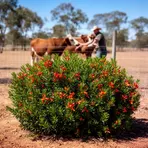
A group of Australian evergreen shrubs that are poisonous to farm animals

An Australian evergreen shrub with bright yellow to red flowers that is poisonous to farm animals
How Toxic
- Australian

 2
3.5
2
3.5

Surface Forms
Morphology
The meaning 'a plant whose parts are poisonous' is straightforwardly derivable from 'poison' (a harmful substance) modifying 'bush' (a shrub/plant). This noun–noun composition follows normal English compounding patterns and is cross-linguistically common, so a B1 learner who knows both constituents will readily understand it.
Etymology
Poison bush names a wild plant whose leaves contain poison, and bush means a wild plant. Farmers fenced their animals away from these plants, so the name now means 'a plant harmful to farm animals'.