
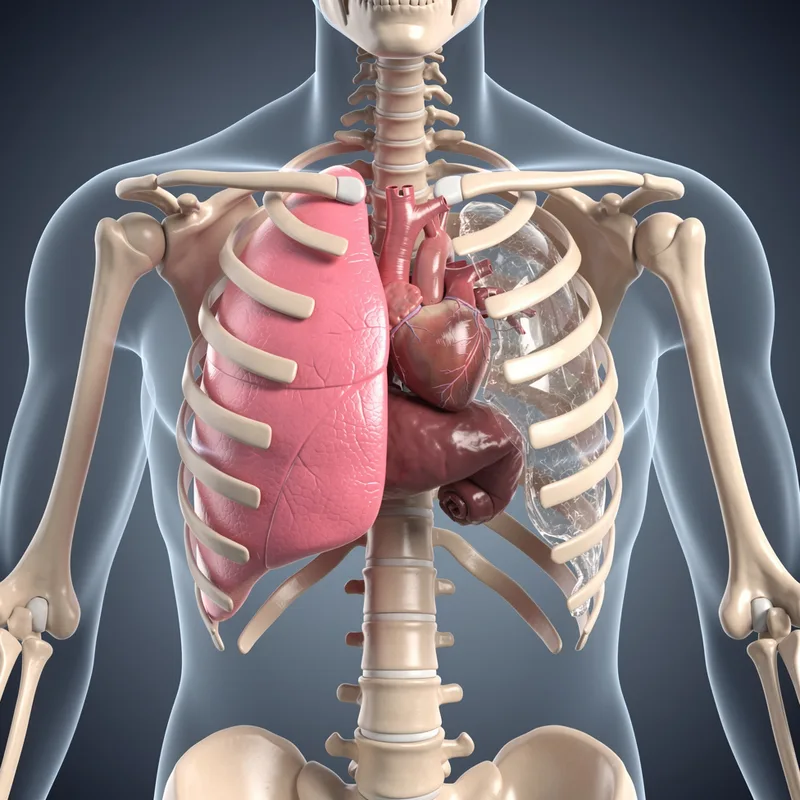
pneumothorax
 12
9.6
12
9.6

- noun
- /ˌnjuːməˈθɔræks/
- Specialized
- The emergency team rushed the patient to surgery to treat the pneumothorax caused by a knife wound.
- spontaneous pneumothorax
- recurrent pneumothorax
- pneumothorax or pleural effusion
Loading YouTube…
Watch on YouTubeOK, basically tension pneumothorax, sucking chest wound, whatever you want to call it, slap these on.
- OK, basically tension pneumothorax, sucking chest wound, whatever you want to call it, slap these on.
Examples
-
Chest X-ray showed a pneumothorax on the base and top of the left lung, with little pleural effusion.
Academic text (2007) -
Chest X-ray again showed a large left pneumothorax.
Academic text (2007) -
The lungs were fully expanded, and no pneumothorax was seen.
Academic text (2003) -
There's a pneumothorax in the left chest, but that was taken care of by the chest tube.
-
Recovery was uneventful, and the patient was discharged without any signs of pneumothorax 5 days after she was admitted.
Academic text (2007) -
No evidence of pneumothorax or pleural effusion was seen.
Academic text (2006) -
Chest X-ray showed a new left pneumothorax, this time with evident subcutaneous emphysema.
Academic text (2007) -
The presence of pneumothorax or hemothorax found by thoracocentesis indicates injuries to the lungs and pleura.
Academic text (2018) -
The doctor explained that the patient had a pneumothorax, which meant air was trapped in the chest cavity.
-
After the accident, the X-ray revealed a pneumothorax in the right lung, leading to a collapsed lung.
How Severe
- Specialized
3
8.6

- Specialized
12
9.6
Surface Forms
Morphology
Etymology
Pneumothorax comes from Greek parts pneumo- meaning 'air' or 'breath' and -thorax meaning 'chest'. So the word literally says 'air in the chest', which helps you remember that a pneumothorax is when air gets into the space around the lung and can make the lung collapse.