
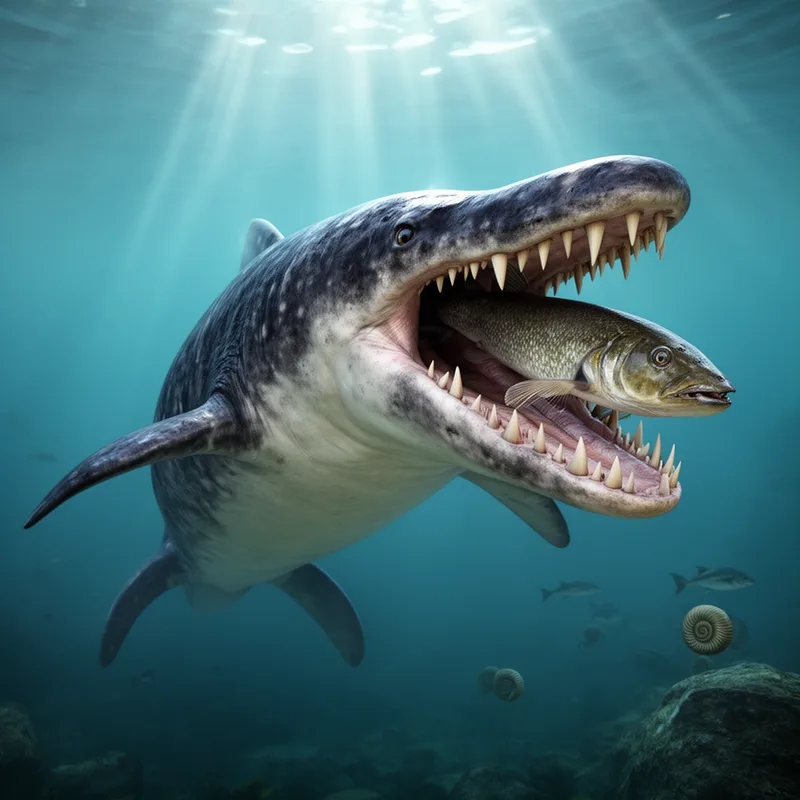
pliosaur
 1
9.9

- noun
- /ˈplaɪəˌsɔr/
- Specialized
- This oceanic hunter was big and terrifying, that's beyond question, but the pliosaur fossils are not quite so big or spectacular as the media feeding frenzy suggested.
Examples
-
Furthermore, Knutsen and collaborators "urge caution in drawing far-reaching conclusions of pliosaur ecology and behavior" based upon their study.
Blog text (18) -
Pliosaurs had huge heads with stout teeth.
Academic text (1995) -
Pliosaurus funkei is only the fourth pliosaur species ever discovered.
Blog text (18) -
It had more teeth than other Pliosaurs.
Blog text (18) -
All this said, Pliosaurus funkei is still one of the largest pliosaurs ever discovered.
Blog text (18) -
Back in 2009, we told you about Predator X, a gigantic pliosaur whose fossilized remains were found in the Arctic.
Blog text (18) -
Interestingly, its limb proportions were quite different compared to other pliosaurs.
Blog text (18) -
In addition to the long-necked plesiosaurs, a short-necked variety, known as pliosaurs, plied the Mesozoic seas.
Academic text (1995) -
They suggest that this is because ichthyosaurs had a similar need to detect the bioluminescence stimulated by large moving objects, perhaps pliosaurs or other ichthyosaurs.
Blog text (13) -
During the Mesozoic era, the pliosaur swam through the oceans with its powerful jaws and short neck.
Synonyms

 1
9.9
A large extinct marine reptile with a short neck and powerful jaws from the Jurassic seas
Surface Forms
Etymology
Pliosaur comes from Greek parts plio- ('more') and -saur ('lizard'), the same -saur you see in dinosaur. So a pliosaur is like a 'more' or bigger sea lizard — imagine a large, extinct marine reptile with a short neck and very powerful jaws.