
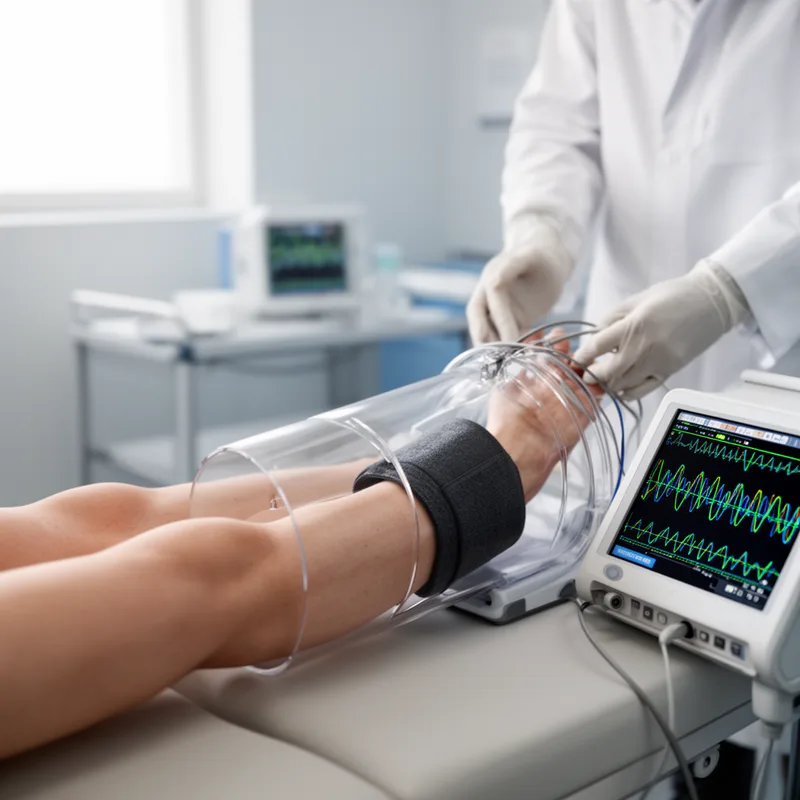
plethysmography


 1
9.9
- noun
- /pləˌθɪzˈmɒɡrəfi/
- NSFW
- The doctor performed plethysmography to assess the patient's blood flow in their legs.
- penile plethysmography
- Plethysmography results
Examples
-
Forearm blood flow was measured in both arms with venous occlusion plethysmography with temperature-compensated mercury in silastic strain gauges.
Academic text (1992) -
We measured tPTEF/tE by respiratory inductance plethysmography in newborn infants of mothers recruited to the Western Australian Pregnancy Cohort Study (WAPCS).
Academic text (1999) -
We used uncalibrated inductance plethysmography.
Academic text (1999) -
Additionally, the effect of an incentive on the ability to fake on penile plethysmography was evaluated.
Academic text (1991) -
Penile plethysmography is considered a promising procedure for the assessment of sexual arousal and orientation.
Academic text (1991) -
Empirical data have consistently upheld the usefulness of penile plethysmography with a variety of clinical populations.
Academic text (1991) -
Penile plethysmography is currently regarded as a promising method of assessing erotic preference (Rosen & Beck, 1988).
Academic text (1991) -
Researchers used plethysmography to measure changes in lung capacity during the experiment.
-
During the study, plethysmography was utilized to evaluate the body's response to different stimuli.
Surface Forms
Morphology
plethysmography = plethysm + graphy
Although '-graphy' suggests a recording or measurement method, 'plethysm' is a highly specialized scientific element, so the full meaning is not readily inferable for an average learner.
Etymology
Plethysmography comes from the parts plethysmo- meaning 'full' or 'swelling' (think of plethora, 'a lot') and -graphy meaning 'writing' or 'recording'. So, plethysmography is like 'writing down' how full or swollen a body part is, which is why the test measures changes in blood flow or the air in the lungs.