
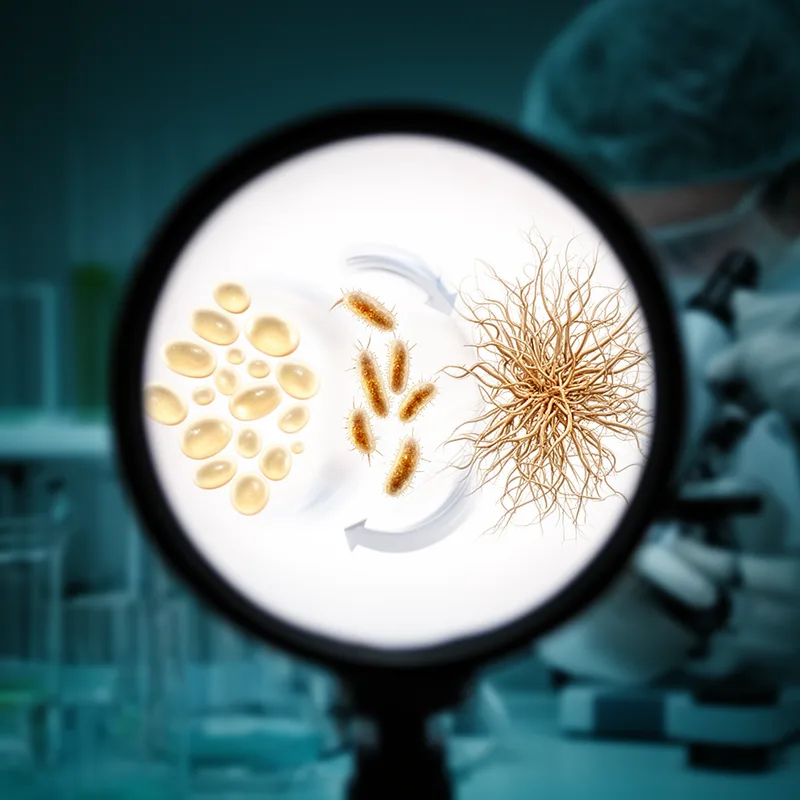
pleomorphism
- noun
- /ˌplēəˈmôrfɪzəm/
- Specialized
- In biology, pleomorphism refers to the ability of some organisms to exhibit distinct forms at different stages of their life cycle.
- cells showing pleomorphism
- nuclear pleomorphism
Examples
-
Some fungi display pleomorphism, changing their shape depending on environmental conditions and growth phases.
-
The presence of pleomorphism in certain bacteria allows them to adapt to changing environments during their development.
-
Characteristically, mild nuclear pleomorphism is seen.
Academic text (2004) -
Mild-to-moderate nuclear pleomorphism was noted, but mitoses were not apparent.
Academic text (2006) -
These findings were in contrast with those of the patient's previous biopsy specimens, which lacked nuclear pleomorphism.
Academic text (2006) -
There was no sign of malignancy, such as increased mitosis or cellular pleomorphism.
Academic text (2005) -
Tumors are classified as low-grade or high-grade, depending on their cellularity, pleomorphism, and mitotic activity.
Academic text (2006) -
Microscopically, rhabdomyosarcoma can be distinguished by the presence of atypical mitotic figures, nuclear pleomorphism, and foci of invasion.
Academic text (2005) -
High-power image (B) shows numerous cells with moderate pleomorphism and hyperchromatism, and bland salt-and-pepper nuclei.
Academic text (2008) -
Histology confirmed features of dense-core granules, tumor cells separated by fibrous stroma, and cells showing pleomorphism and hyperchromatism.
Academic text (2008)
Synonyms


 1
9.9
1
9.9
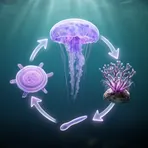
A life cycle in which a plant or animal changes between different forms

A life cycle with stages that reproduce sexually and stages that reproduce without sex

A life cycle in plants and some algae with two different forms, one sexual and one asexual
Surface Forms
Morphology
pleomorphism = pleomorphic (semi-transparent) = pleo + morph + ism
Derived from the adjective 'pleomorphic' with the noun-forming suffix '-ism'; the combining form 'pleo-' is uncommon, so the morphological relation is only partly obvious to non-specialists.
Etymology
Pleomorphism comes from the Greek parts pleo- 'many' and -morph 'shape', the same root you find in metamorphosis. That's why pleomorphism describes an organism that can appear in two or more different forms during its life, like some fungi that are sometimes yeast and sometimes mold.