
play therapy
 1
4.7
1
4.7

- noun
- /pleɪ ˈθɛrəpi/
- Specialized
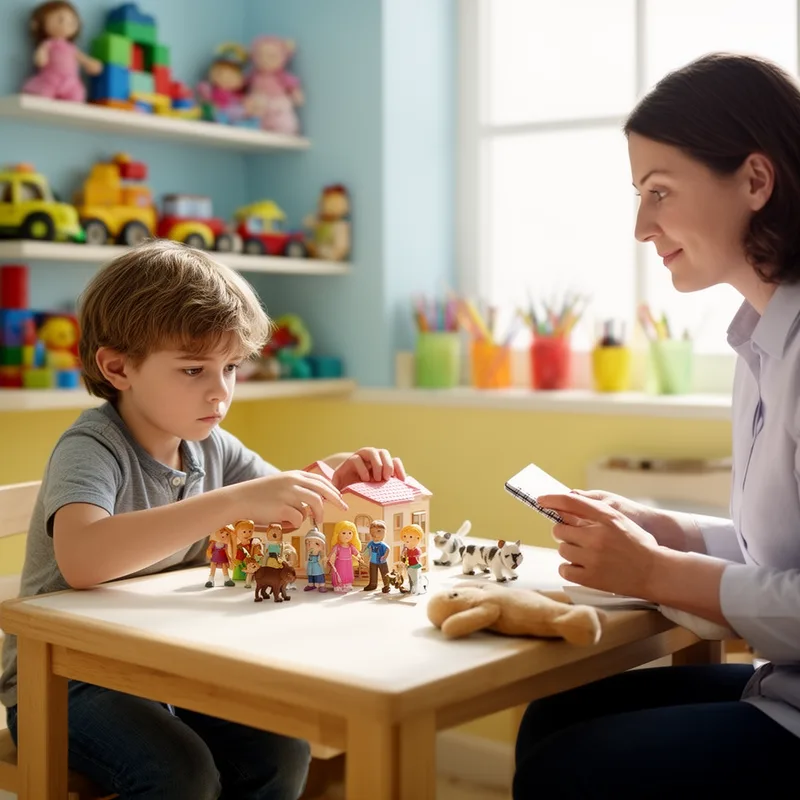
- Many therapists find that play therapy is particularly effective for helping children cope with trauma.
- play therapy with children
- play therapy session
- a therapeutic approach of play therapy
Loading YouTube…
Watch on YouTubeNo, we use play therapy techniques to help kids develop coping thoughts.
- No, we use play therapy techniques to help kids develop coping thoughts.
Examples
-
Schools provide an ideal setting for play therapy, as all children have access to school counselors.
Academic text (2013) -
As previously mentioned, play therapy can be an extremely effective method of counseling when working with adolescent students.
Academic text (2013) -
Time constraints may be another concern in play therapy in the school environment.
Academic text (2013) -
There are many responses a therapist might use during the course of play therapy.
Academic text (2007) -
Many challenges in play therapy are due to misconceptions about the play therapy process.
Academic text (2013) -
Another common misconception is that play therapy is only appropriate in elementary school settings.
Academic text (2013) -
Due to cultural differences, monocultural play therapy techniques may not be suitable for all children.
Academic text (2007) -
Consideration of these variables is expected to enhance therapeutic outcomes in play therapy with Japanese children.
Academic text (2008) -
School counselors also grapple with adhering to the least restrictive therapeutic environment in play therapy.
Academic text (2013) -
Facilitative responses, a child-centered play therapy technique, demonstrate sensitivity, awareness, and reflection of student feelings (Landreth, 2012).
Academic text (2013)
Synonyms
 862
3.2
862
3.2
Treatment given to help physical or mental health problems
Surface Forms
Morphology
The meaning 'a form of psychotherapy using play' is directly and transparently derived from combining 'play' (playful activity) with 'therapy' (psychological treatment); the compound straightforwardly denotes therapy that uses play. This compositional pattern is common and similar across languages, so a B1 learner who knows both constituents will likely understand the MWE.
Etymology
The term play therapy comes from the simple idea that children show their feelings with play, using toys and games, while a therapist uses therapy to listen and guide them. So, it means 'using play to help children express feelings and heal'.