
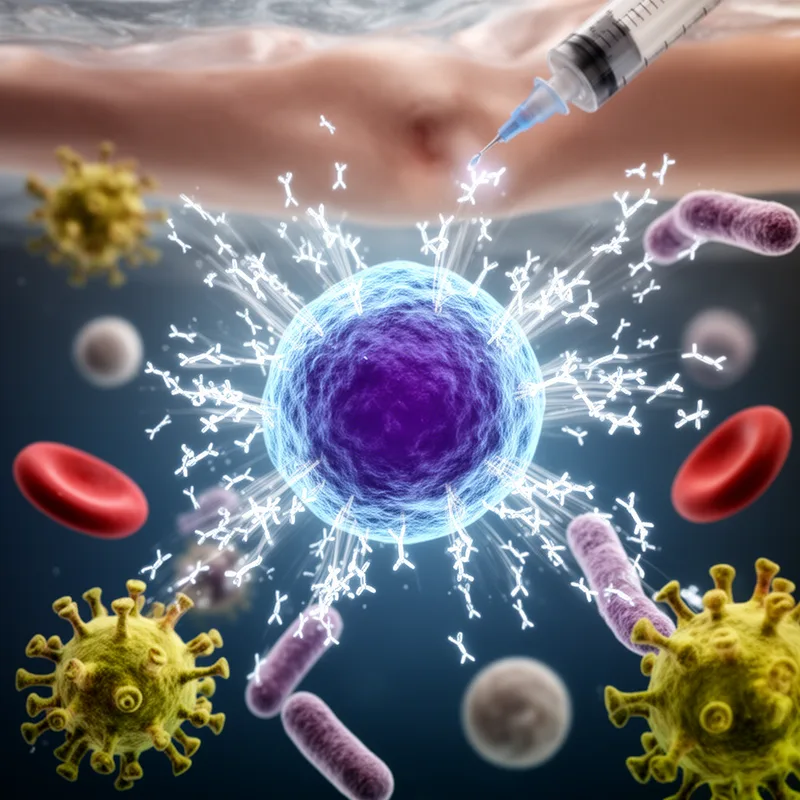
plasmablast


 1
9.4
- noun
- /ˈplæzməˌblæst/
- Specialized
- A plasmablast is essential for antibody production.
Examples
-
Researchers observed a significant increase in plasmablasts following vaccination.
-
The differentiation of a plasmablast into a plasma cell is a crucial immune process.
-
Flow cytometry is commonly used to identify plasmablast populations in blood samples.
-
These plasmablasts play a crucial role in the immune response.
-
The body's immune response triggered many plasmablasts that started producing antibodies.
-
In response to the infection, several plasmablasts were activated to help fight the germs.
-
The research showed that plasmablasts play a crucial role in generating a quick antibody response during illness.
Surface Forms
Morphology
Etymology
Plasmablast combines plasma and blast. Here plasma points to the 'plasma cell' that makes antibodies, and blast comes from an old word meaning 'sprout' or 'young', so a plasmablast is an early, sprouting cell that begins to make antibodies.