
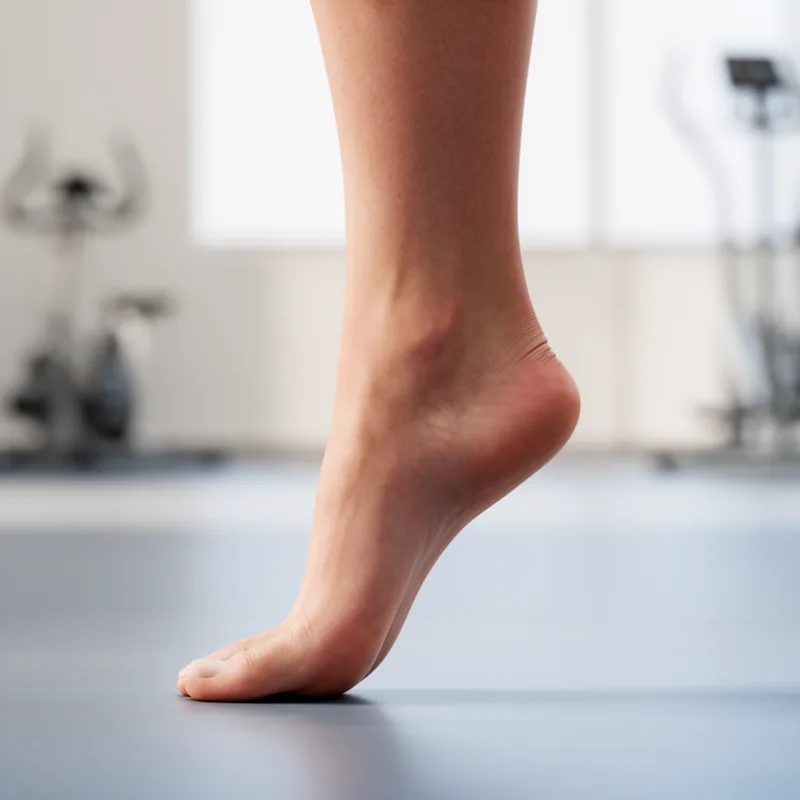
plantarflexion


 1
8.7
- noun
- /ˌplæntɑːrflɛkˈʃən/
- Specialized
- During physical therapy, the patient performed exercises that involved plantarflexion to strengthen their calf muscles.
- plantarflexion movement
- plantarflexion alignment
- ankle plantarflexion
Examples
-
During walking, maximum ankle dorsiflexion decreased and ankle plantarflexion increased.
Academic text (1999) -
Occasionally, in the most severe cases, serial casting of the foot in plantarflexion and inversion can be done to facilitate correction.
Academic text (2005) -
Table 2 shows that the maximum dorsiflexion angle decreased and the maximum plantarflexion angle increased.
Academic text (1999) -
The mean ICR location shifted significantly backward when the trim line stage increased in plantarflexion movement.
Academic text (1997) -
Dorsiflexion movement caused significantly wider lCR scatter than plantarflexion movement.
Academic text (1997) -
Uncontrolled motion at the subtalar joint can produce apparent plantarflexion or dorsiflexion.
Academic text (2001) -
The angular adjustments at the alignment jig were 12 degrees for plantarflexion and 4 degrees for dorsiflexion.
Academic text (1993) -
Plantarflexion was simulated during the loading of the prosthetic limb as body weight compressed a cushion heel.
Academic text (1990) -
Articulation is also required when adjusting the resistance to dorsi- or plantarflexion movements to improve discomfort resulting from hyperrigidity during the use of PAFOs.
Academic text (1997) -
Regarding the transverse ICR distribution, dorsiflexion movement created significantly further backward ICR deviation than plantarflexion movement in the 20 percent-trimmed PAFOs alone.
Academic text (1997)
Antonyms

Surface Forms
Morphology
Etymology
Plantarflexion comes from plantar ('sole', the bottom of the foot) and flexion (from flex, 'to bend'). So plantarflexion means bending at the ankle to make the toes point down, as when you push off to walk or point your foot in ballet.