
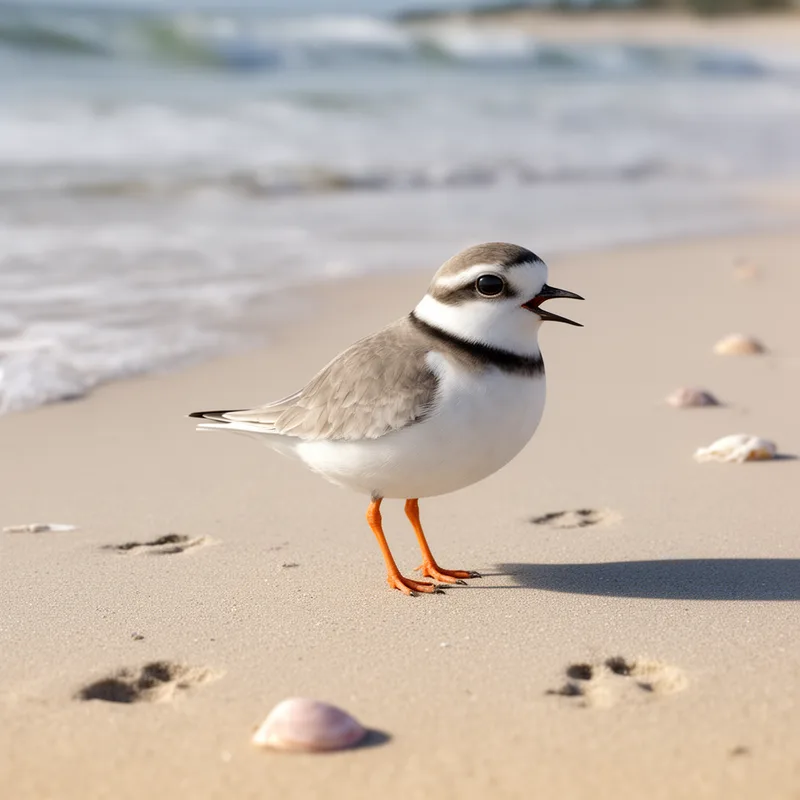
piping plover
 1
9.9
1
9.9

- noun
- /ˈpaɪpɪŋ ˈploʊvər/
- US
- The endangered piping plover nests along the sandy beaches of the eastern coast.
- piping plover nests
- endangered piping plover
- endanger piping plovers
Examples
-
Piping plovers move through early in the season.
Blog text (13) -
Speaking of the piping plover in Chicago, do you still have those wonderful, but not indigenous green parrots in Hyde Park?
-
Dredging is usually prohibited during winter flounder and piping plover mating seasons.
Blog text (28) -
In 2012, there were 22 piping plover nests on the Seashore, 88 chicks, but only 11 survived.
Blog text (13) -
I consider it a privilege to live in one of the last seafront bastions of the tiny, harmless piping plover (there are fewer than 2,000 nesting pairs left on the Atlantic coast, according to the U.S. Fish and Wildlife Service).
Blog text (20) -
One of the most contentious debates in the region centers on the flow of the Platte River to sustain migrating populations of whooping cranes and piping plovers.
Academic text (2003) -
Conservationists are working hard to protect the piping plover and its habitat from development.
-
In spring, the piping plover returns to its breeding grounds, where it is known for its distinctive call.
Synonyms
A small beach bird found in eastern North America with pale feathers and a high clear call
Surface Forms
Morphology
The compound is a straightforward modifier-noun combination: 'piping' (making a thin, high-pitched sound) + 'plover' (a wading bird) yields a bird characterized by its piping call. A B1 learner who knows both constituent meanings can readily infer this is a (small shore) bird that utters a piping whistle, so the meaning is compositional and cross-linguistically transparent.
Etymology
Piping plover The name piping plover comes from the bird's soft, high call. Piping describes its clear whistle and plover is a word for a small shorebird, so the name refers to the little pale bird you can hear whistling on sandy beaches.