
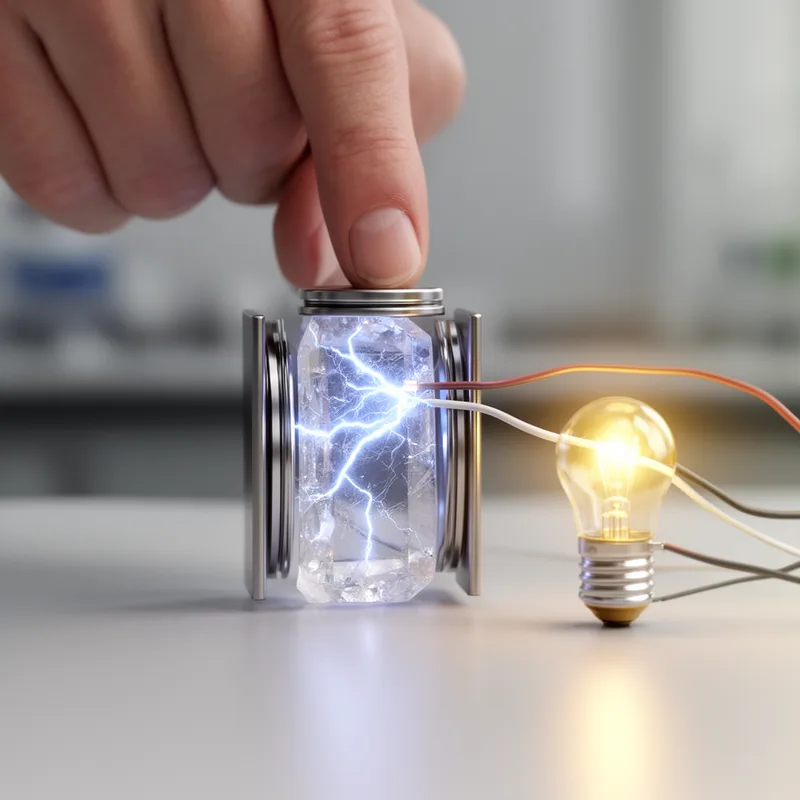
piezoelectric crystal


 1
7.5
1
7.5
- noun
- /ˌpiːeɪzoʊɪˈlɛktrɪk ˈkrɪstl/
- Specialized
- Piezoelectric crystals bonded to a metal diaphragm are stressed and distorted by an electric field, which flexes the diaphragm.
Examples
-
A piezoelectric crystal can convert mechanical vibrations into electrical signals, making it essential for various electronic devices.
-
The fork-shaped sensors contain two piezoelectric crystals; one acts as the ultrasonic transmitter, the other as a receiver.
Academic text (1998) -
Here, a piezoelectric crystal was used to generate the high-frequency waves necessary.
Academic text (2007) -
He was trying to describe a massive piezoelectric crystal cluster.
-
And then he gives that piezoelectric crystal a pulse of voltage, which jerks it.
-
In many smartphones, a piezoelectric crystal is used to detect sound waves during voice recognition.
-
The engineer explained that a piezoelectric crystal generates an electric charge when it is compressed or stretched.
Surface Forms
Morphology
The meaning is directly derivable by combining the adjective 'piezoelectric' (producing an electric charge under mechanical stress) with 'crystal' (a solid with a repeating lattice), yielding 'a crystal that generates electric charge when stressed.' This is a straightforward adjective + noun composition following normal English patterns, so a learner who knows both constituents will understand the MWE.
Etymology
Piezoelectric crystal comes from the parts piezo, meaning 'to press', electric, meaning 'electricity', and crystal, the hard mineral. The name gives a clear picture: press a crystal and it makes a small electric charge, which is why these crystals are used to make and pick up electric signals.