
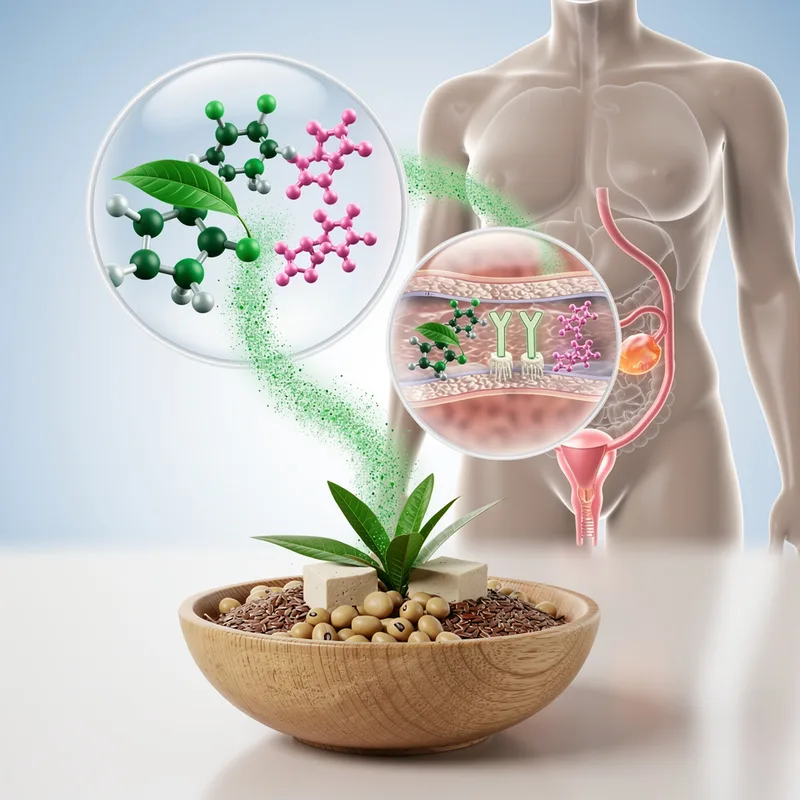
phytoestrogen
 1
7.5

- noun
- /ˌfaɪtoʊˈɛstrədʒən/
- Specialized
- It's already known that populations eating a diet rich in soybean phytoestrogens have lower incidences of several diseases, including breast and prostate cancer.
- phytoestrogens, lignans
- phytoestrogens called isoflavones
- contain phytoestrogens
Loading YouTube…
Watch on YouTubeThey, they, they have a huge, their diet is very rich in phytoestrogens, a lot of soy, a lot of fermented soy.
- They, they, they have a huge, their diet is very rich in phytoestrogens, a lot of soy, a lot of fermented soy.
- All grains contain phytoestrogens which are going to effectively raise your estrogen and therefore muck up your testosterone to estrogen ratio.
- It's got phytoestrogens as well as isoflavones.
- So like be I want you to be like really clear about soy estrogens, phytoestrogens, the differences.
Examples
-
Many health experts recommend incorporating foods rich in phytoestrogen into your diet for better hormonal balance.
-
Another food group that helps to increase breast size is known as the phytoestrogen group, of which seafood is a part.
Blog text (25) -
For instance, raising glycitein content to the same amount as that of daidzein could double the total phytoestrogen content.
Blog text (27) -
Most of the phytoestrogens come from legumes such as non-GMO soy.
Blog text (29) -
Soya products are a rich source of phytoestrogens, which have been shown to alleviate menopausal symptoms. They can also contribute to a healthy diet.
Academic text (2012) -
There are over 200 non-medical treatments, including relaxation and meditation techniques, and numerous botanical options such as Evening Primrose Oil, Red Clover, Black Cohosh, and phytoestrogens.
Academic text (2012) -
Certain beans and legumes are abundant sources of phytoestrogen, which can mimic the effects of estrogen in the body.
-
For women experiencing menopause, increasing phytoestrogen intake may help alleviate some of the associated symptoms.
Surface Forms
Morphology
Etymology
The word phytoestrogen joins phyto- meaning 'plant' and estrogen, the female hormone. So, a phytoestrogen is a 'plant' compound that acts like 'estrogen' in the body.