

phylum Echinodermata
- noun
- /ˈfaɪləm ˌɛkɪnəˈdɜrmætə/
- Specialized
- The phylum Echinodermata is characterized by radial symmetry and a hard calcareous skeleton.
Examples
-
Starfish and sea cucumbers are part of the phylum Echinodermata.
-
Biologists often study the regenerative abilities of animals in the phylum Echinodermata.
-
The phylum Echinodermata includes fascinating creatures like starfish and sea cucumbers.
-
Starfish belong to the phylum Echinodermata.
-
Starfish and sea cucumbers are part of the phylum Echinodermata.
-
The phylum Echinodermata is characterized by radial symmetry and a hard calcareous skeleton.
-
Biologists often study the regenerative abilities of animals in the phylum Echinodermata.
Synonyms
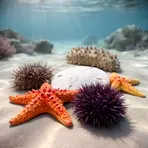
A group of sea animals with spiny skin, like starfish and sea urchins
Surface Forms
Morphology
This is a fully compositional technical noun phrase: 'phylum' (a taxonomic rank) combined with the proper taxon name 'Echinodermata' denotes exactly the taxonomic group. A learner who knows both constituents can directly infer it refers to the phylum comprising radially symmetrical marine invertebrates; taxonomic naming is cross-linguistically similar and follows predictable composition.
Etymology
The name phylum Echinodermata comes from Greek words echino ('spiny') and dermata ('skin'), so it literally means 'spiny skin'. Think 'spiny skin' to remember animals like starfish, sea urchins and sea cucumbers that have hard, bumpy bodies.

