
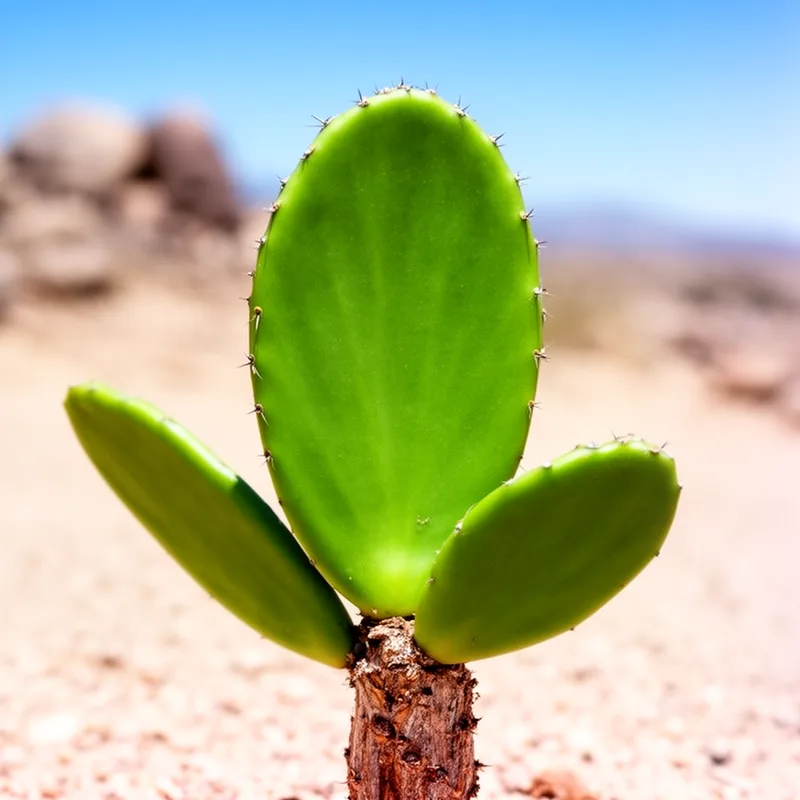
phylloclad
- noun
- /ˈfɪl.əˌklæd/
- Specialized
- The cactus relies on its phylloclad for photosynthesis instead of true leaves.
Examples
-
Some plants develop a phylloclad as an adaptation to reduce water loss.
-
Botanists observed that the phylloclad allowed the plant to survive in arid conditions.
-
The phylloclad of the plant serves as a photosynthetic organ.
-
Some species of cacti have a phylloclad structure.
-
The phylloclad of the cactus functions like a leaf to help it photosynthesize.
-
In certain plants, the phylloclad replaces traditional leaves and aids in water retention.
-
The unique phylloclad structure enables the plant to thrive in dry environments.
Synonyms

A flat stem that looks like a leaf and makes food for the plant

A flat stem that looks like and works as a leaf

A flat stem that looks like a leaf and makes food for the plant, for example in cactus plants
How Leaf-Like


Surface Forms
Morphology
phylloclad = phyllo + clad (semi-transparent) = phyllo + clad
The form is transparently built from botanical combining forms 'phyllo-' and '-clad', but these are specialised morphemes unlikely to be known by general learners.
Etymology
Phylloclad comes from Greek parts phyllo 'leaf' and -clad 'branch'. A helpful image is a 'branch pretending to be a leaf'—a flattened stem that looks and works like a leaf to help the plant make food and save water.