
photosphere
 3
9.6
3
9.6

- noun
- /ˈfoʊtəˌsfɪr/
- Specialized
 :
fotosfera
:
fotosfera
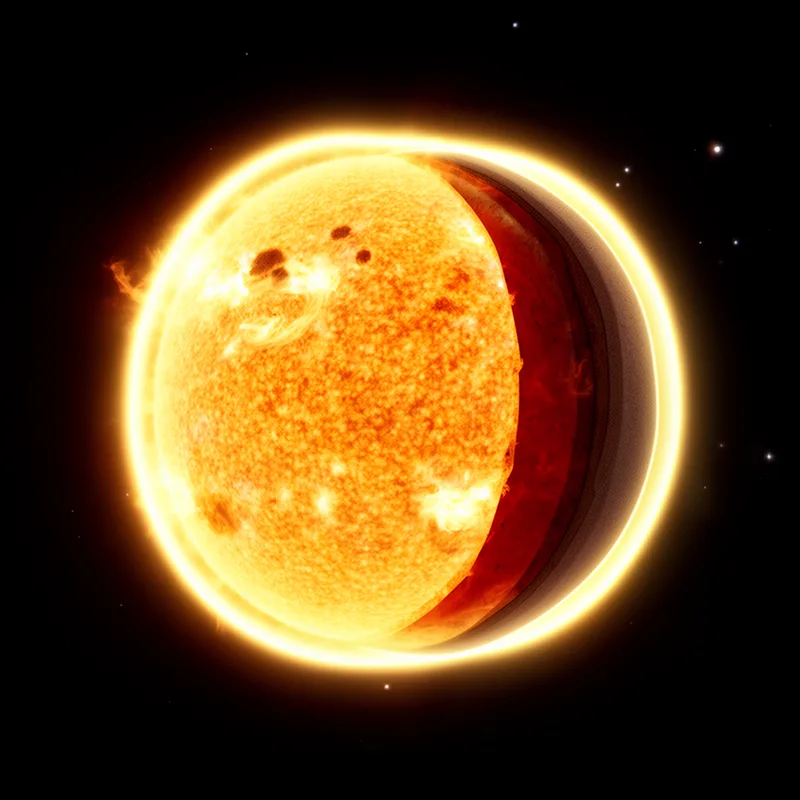
- The sun's surface layer, known as the photosphere, emits the bright light that we see during the day.
- solar photosphere
- the photosphere of the sun
- the photosphere of a star
And the point at which it suddenly can move freely is is this point the photosphere.
- And the point at which it suddenly can move freely is is this point the photosphere.
Examples
-
Beneath the photosphere is the solar interior.
Academic text (1991) -
Yet the Sun's "surface," the photosphere, radiates mostly visible light.
Academic text (2001) -
The visible "surface" of the Sun is called the photosphere.
Academic text (2004) -
Outside the path, over a much larger area of Earth, the Moon only blocks the view of part of the photosphere.
Academic text (2000) -
Sunspots appear dark because they are giving off less radiation than the photosphere that surrounds them.
Academic text (1991) -
There and only there, for a few precious minutes, does the Moon completely block the solar photosphere, the surface layer of gases from which most of the Sun's light escapes.
Academic text (2000) -
By the time hot solar gas reaches the photosphere ("sphere of light" in Greek), it has a temperature of about 5800 kelvins.
Academic text (2001) -
A solar storm involves energetic particles released from the photosphere, impacting satellites in orbit.
-
Astronomers study the photosphere to understand the sun's activity and its effects on Earth.
Surface Forms
Morphology
Etymology
Photosphere comes from photo- 'light' (as in photograph) and sphere 'ball' or 'globe'. So the sun's photosphere is the bright 'light ball' layer we see that gives off most of its visible light.